
 EN
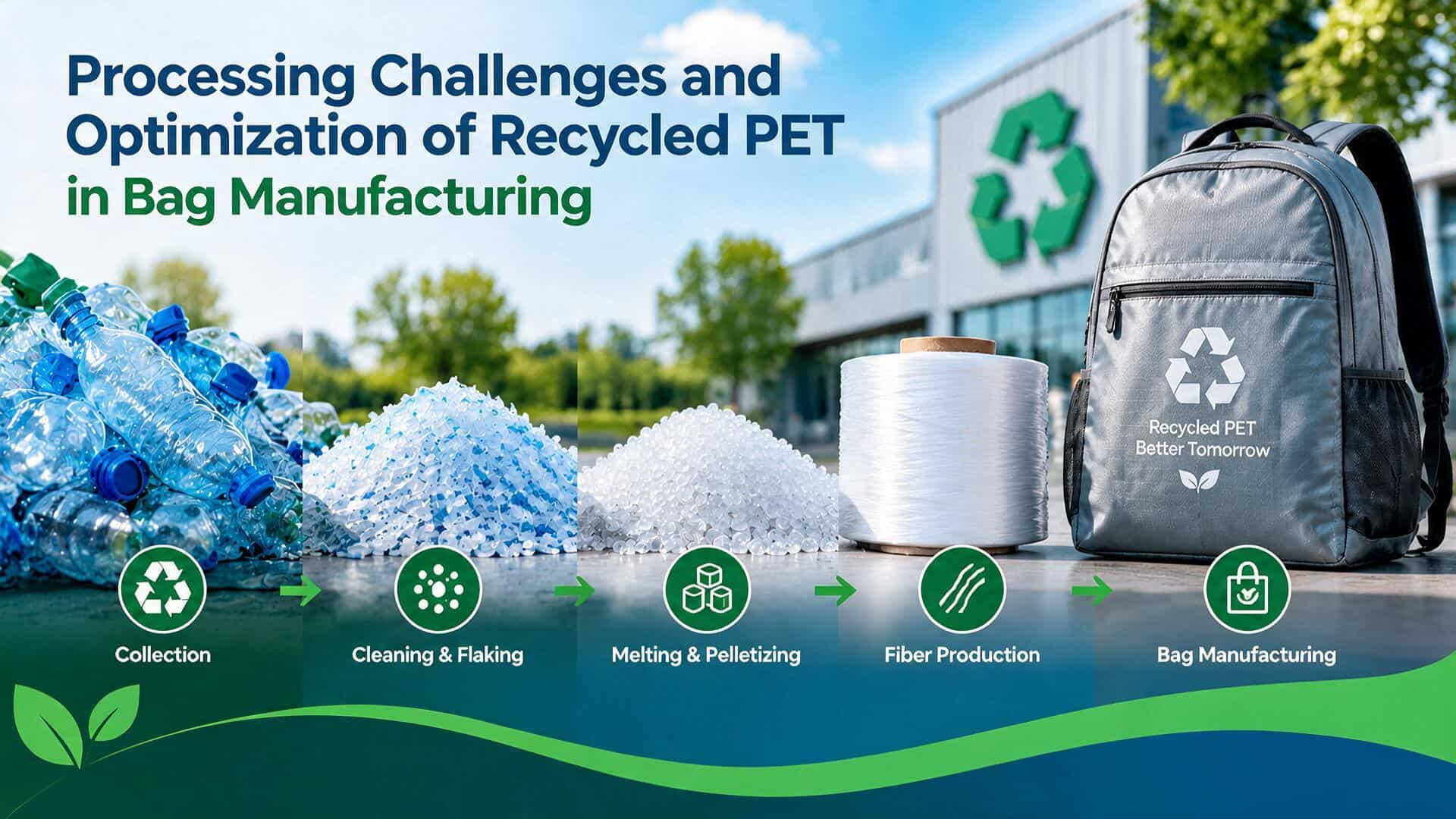
1. Introduction: The Green Transition in the Bag Industry
In the traditional bag manufacturing industry, polyester fibers and rigid PET sheets have always been the primary structural materials due to their excellent tensile strength, wear resistance, and cost advantages. To reduce carbon footprint, adopting RPET (Recycled PET) produced from recycled waste plastic bottles as a substitute for virgin polyester has become an inevitable choice for current large-scale production and eco-design.
However, from the perspective of engineering materials science, the high heat, shear force, and environmental aging during plastic recycling inevitably lead to the breakage of PET molecular chains (thermal degradation and hydrolysis), thereby altering its physical and mechanical behaviors. These changes can present a range of processing challenges when manufacturing highly precise, personalized custom bags.
2. Key Processing Challenges of RPET in Bag Manufacturing
2.1 Soft Textile Processing: Yarn Strength Variations and Breakage Risks, Sewing Heat Damage, and Needle-Hole Tearing
In the manufacturing of soft bags, RPET is typically utilized in the form of recycled polyester fabric for the body, lining, and other components, but there are certain risks associated:
-
- Yarn Strength Variations and Breakage Risks: The mechanical recycling process may lead to degradation of polyester molecular chains, and residual impurities may also affect spinning quality, thereby affecting the strength, uniformity, and processing stability of some RPET fibers or yarns. During spinning and weaving, these differences may increase the risk of yarn breakage.
- Heat Damage and Needle-Hole Tearing during sewing: The heat generated by high-speed sewing may damage the sewing thread or heat-sensitive fabrics. In addition, the stress concentration at the needle hole may increase the risk of fabric tearing.
2.2 Hard-Shell and Structural Component Forming: Melt Rheology Changes and Forming Defects
In the manufacturing of hard shells for trolley cases, support plates for carrying systems, and internal partitions for functional bags, some products utilize processes such as RPET sheet extrusion, thermoforming, or injection molding. The rheological properties and moisture content control of recycled materials directly affect processing stability and finished product quality.
-
- Melt Viscosity Changes and Forming Stability: Mechanical recycling and subsequent thermal processing may lead to the degradation of PET molecular chains, resulting in a decrease in the intrinsic viscosity (IV) of some RPET, a subsequent reduction in melt viscosity, and an increase in melt flow rate (MFR). During the extrusion process of sheets, changes in the rheological properties of the melt may increase the difficulty of thickness control, affecting the uniformity of the sheets and the mechanical properties of the final products.
- Moisture Control and the Risk of Hydrolytic Degradation: PET is sensitive to the moisture content before processing. If the RPET raw material is not fully dried, residual moisture may cause hydrolysis during the high-temperature melting process, further leading to molecular chain breakage, decrease in molecular weight and intrinsic viscosity, and affecting the processing stability and mechanical properties of the finished product. At the same time, moisture and other volatiles may also cause surface defects such as bubbles and silver streaks in molded products.
2.3 Surface Treatment Challenges: Poor Coating Adhesion and Reduced Durability
In the production of bag, some RPET fabrics require PU/PVC coating treatment to meet requirements such as waterproofing, wear resistance, or aesthetic design. If the bonding between the coating and the fabric is not strong enough, the fabric may exhibit cracking, peeling, or delamination of the coating after repeated bending, rubbing, or scratching. In the corners, seams, and repeatedly bent areas of bag, such issues may further compromise the integrity and waterproof performance of the coating.
3. Strategies for Overcoming Processing Challenges
In order to effectively apply RPET in bag manufacturing and meet the requirements of product durability, processing stability, and appearance quality, factories need to develop targeted process control and quality verification schemes based on the material characteristics of different processing stages.
3.1 Optimizing Soft Textile Processing and Sewing
-
- Strengthening Raw Material Quality and Yarn Performance Control: Select RPET yarn and fabric with stable quality and traceable sources, and inspect the yarn strength, uniformity, and fabric tear strength according to product requirements to reduce the impact of raw material performance fluctuations on textile processing and subsequent sewing quality.
- Optimizing Sewing Parameters and Needle–Thread Matching: Based on the thickness, texture, and strength of the fabric, the appropriate selection of machine needle type, needle size, sewing thread, and sewing speed is crucial to minimize damage to the fabric caused by improper needle-thread combinations or excessively high processing speeds.
3.2 Optimization of Hard-Shell and Structural Component Forming Processes
-
- Controlling Raw Material Moisture Content and Processing Conditions: Based on the specifications of RPET raw material, establish appropriate drying conditions and control the moisture content of the raw material prior to melt processing to reduce the risk of hydrolytic degradation during high-temperature processing. When necessary, assess whether the raw material meets processing requirements by combining indicators such as intrinsic viscosity (IV).
- Optimizing Extrusion and Forming Parameters: Based on the rheological properties of the material, adjust the processing temperature, screw speed, die parameters, and traction speed reasonably, and monitor the pressure and plate thickness changes during the extrusion process to improve the stability and uniformity of plate molding. For production lines with fluctuating output or unstable extrusion pressure, assess the applicability of equipment such as melt pumps.
3.3 Optimization of Surface Treatment Processes
-
- Controlling Substrate Surface Conditions: Before coating treatment, ensure that the surface of RPET fabric is clean and dry, reducing the impact of oil, dust, and other residues on the coating adhesion effect.
- Optimizing Coating Systems and Treatment Processes: Based on the fabric structure, coating material, and product application, select the appropriate PU/PVC coating formula and processing parameters. When necessary, evaluate options such as corona treatment, plasma treatment, or primer application to enhance the adhesion between the coating and the fabric.
4. Finished Product Performance Testing for RPET Bags
Any process improvement needs to be supported by data. After the completion of mass production of bag, mechanical performance tests for RPET bag should be more stringent than those for regular products.
4.1 Fabric and Seam Strength Testing
A tensile testing machine is used to conduct tensile and tear strength tests on fabrics, as well as tensile tests on handles, shoulder straps, and key seams, to check whether the fabric is torn, whether the stitches are broken, or whether the seams are slipping. For load-bearing parts, durability can also be evaluated through repeated loading tests.
4.2 Hard-Shell and Structural Component Performance Testing
For RPET hard shells and support plates, drop hammer impact testing can be used to evaluate the cracking and damage of the material after impact, and to check the thickness uniformity at different locations of the molded parts. If the product needs to adapt to low temperature environments, impact testing under specified low temperature conditions can be added to verify its reliability in the corresponding usage environment.
4.3 Coating Adhesion and Abrasion Resistance Testing
A universal material testing machine is used for coating peeling testing to evaluate the bonding strength between the coating and the RPET fabric. The Martindale Abrasion Tester is employed for repeated friction testing to observe whether the coating exhibits wear, cracking, or peeling. For coated fabrics that require repeated bending, the Flexing Tester can also be used to assess the coating's resistance to bending damage.
5. Conclusion
When applying RPET to bag manufacturing, not only must the environmental properties of the material be considered, but technological challenges in textile sewing, structural molding, and surface treatment must also be addressed. For bag manufacturers, true sustainable manufacturing lies not only in the use of recycled materials, but also in ensuring that these materials meet practical usage requirements through stable production processes and reliable quality control.
Related Reading