 EN
EN


Introduction
As the global trend toward sustainable development gains momentum—exemplified by the European Union's push for a circular textile industry—an increasing number of brands are adopting recycled materials to develop bags. However, for brand buyers, simply labeling a product as "Recycled" is insufficient to prove that it truly meets environmental standards. The GRS certification was established precisely to address this challenge.
1. What is GRS certification?
The Global Recycled Standard (GRS) is a global certification standard for recycled materials launched by the international organization Textile Exchange.
It is primarily used to verify:
-
- Recycled material content in the product
- Source of recycled materials
- Supply chain traceability process
- Environmental and social responsibility requirements during the production process
Simply put, the core function of GRS certification is to help brands verify the authenticity and reliability of recycled materials in their products and ensure that the entire supply chain complies with relevant standards.
2. Why GRS-Certified Recycled Bags Are Gaining Popularity Among Global Brands
2.1 Ensuring the Authenticity and Traceability of Recycled Materials
In recent years, an increasing number of companies have launched eco-friendly product lines, yet a key issue remains in the market: how to prove that the products actually contain recycled materials.
GRS certification involves audits and verification of every stage of the supply chain by professional third-party bodies, ensuring that verifiable records exist for recycled materials—from their recovery sources and processing stages through to the final product. It not only attests to the use of recycled materials in products but also helps brands establish transparent and reliable supply chain management systems.
For buyers, GRS is not merely an eco-label but also a testament to supply chain credibility; this is the primary reason why brands choose GRS certification.
2.2 Aligning with Brands’ Sustainability Strategies and Market Demands
An increasing number of international brands are incorporating sustainability into their long-term strategies—not merely due to environmental principles, but because the market, consumer preferences, and the competitive landscape are evolving.
-
- On the one hand, consumers are paying increasing attention to the environmental impact of products, making sustainable materials an important tool for brands to differentiate themselves in the market.
- On the other hand, sustainable development is influencing brands' product planning, supply chain choices, and market positioning.
Recycled materials have gradually shifted from being merely an "eco-friendly selling point" to becoming a key focus in brand product development.
2.3 Enabling Brands to Make Credible Sustainability Claims
As the market for eco-friendly products continues to grow, it is inevitable that consumers and market regulators will question corporate "greenwashing."
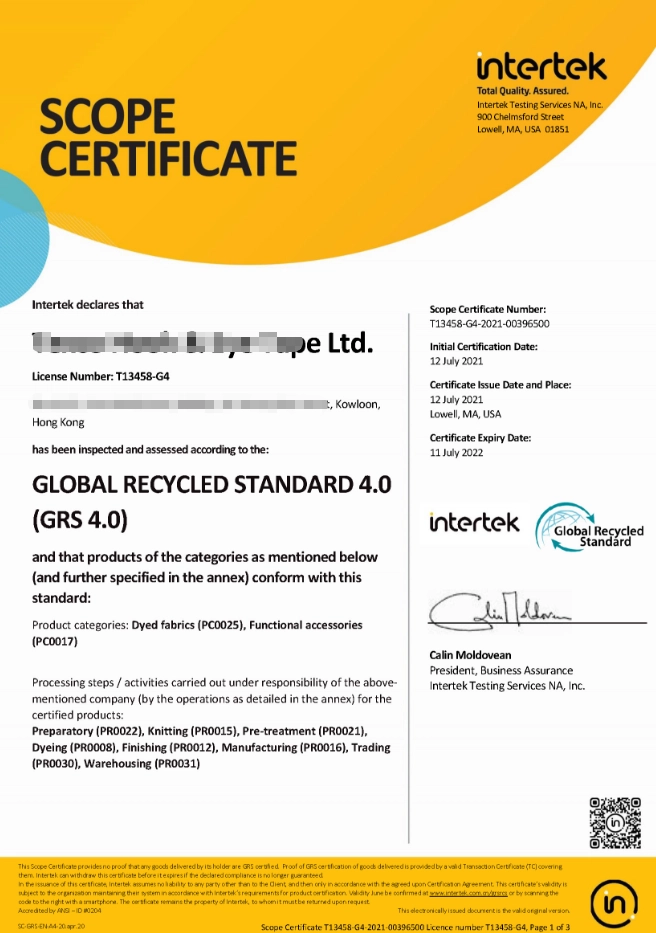
GRS certification can provide a credible basis for a brand's environmental claims. Upon passing an audit by a third-party organization, the GRS certificate clearly specifies the certification standard, product category, and production stages involved, helping brands demonstrate that the sourcing of recycled materials and the production process meet the relevant requirements.
Therefore, GRS-certified bag products not only showcase their eco-friendly attributes but also dispel consumer and market skepticism regarding "green marketing," thereby enhancing the credibility of the brand's commitment to sustainability.
|
Comparison Dimensions |
No GRS Certification |
GRS Certification |
|
Sources of recycled materials |
Relies primarily on information provided by suppliers. |
Passed GRS system audit and supply chain traceability verification. |
|
Authenticity of materials |
Typically, the purchaser is required to verify this independently. |
Audited by a third-party certification body |
|
Supply chain transparency |
Depends on supplier management capabilities. |
Clearer traceability requirements for raw materials, the production process, etc. |
|
Basis for Environmental Statement |
Additional supporting documentation is required. |
GRS certification as supporting evidence |
|
Recognition of international procurement |
Varies depending on supplier qualifications. |
Easier to meet the sourcing requirements of international brands and retailers. |
3. Common Recycled Materials Used in Bag Manufacturing
RPET (Recycled Polyester) is currently one of the most widely used recycled materials in the luggage and bag industry; it is typically made from recycled plastic bottles. Common applications include laptop bags, travel bags, handbags, and outdoor bags.
Its main advantages include:
-
- Lightweight – suitable for travel bags and everyday backpacks.
- Durability – Processed RPET fabric meets the strength and abrasion resistance requirements for bags.
- Mature supply chain — suitable for large-scale bag production and the development of eco-friendly products.
In addition to RPET, recycled nylon is another significant recycled material; primarily used in products requiring high performance, it is characterized by high strength and excellent wear resistance. In addition, depending on the product positioning, the bags may also utilize recycled materials such as recycled cotton and recycled PU (polyurethane) leather.
4. How to Choose a Reliable Supplier for GRS-Certified Recycled Bags
4.1 Verify the Scope of the GRS Certification
Many buyers often misunderstand that holding a GRS certificate means being able to manufacture all GRS products. In practice, the following need to be confirmed at the time of procurement:
-
- Whether the certification scope includes the relevant product categories.
- Whether the certification covers the actual production processes.
For example, a company’s GRS certification might cover only fabric processing; this does not mean it possesses the capability to manufacture bags.
4.2 Assess the Supplier’s Supply Chain and Manufacturing Capabilities
GRS certification is merely the baseline; a reliable supplier must also possess:
-
- Stable supply chain management capabilities for GRS-certified materials, ensuring materials meet order requirements.
- Extensive experience in the application of recycled materials, enabling the recommendation of suitable solutions based on product positioning.
- Mature product development and mass production capabilities enable the transformation of recycled materials into mass-produced products.
4.3 Assess Quality Management Systems and Export Experience
For international buyers, in addition to GRS certification, reliable suppliers must also meet standards regarding quality, social responsibility, and global supply chain management.
-
- Social Responsibility Compliance Capability – Certifications such as BSCI and Sedex, ensuring suppliers meet international brand compliance requirements regarding labor rights, the production environment, and corporate management;
- A comprehensive quality management system—encompassing raw material inspection, in-process inspection, finished product testing, and pre-shipment inspection—ensures consistent quality for large-volume orders.
- Experience in overseas exports – Familiarity with regulatory requirements, packaging standards, and logistics processes in major markets such as Europe and the US, helping to reduce communication costs and supply chain risks in cross-border procurement.
5. Are GRS-Certified Bags More Expensive?
In actual production, the cost of GRS-certified bags may be influenced by the following factors:
5.1 Cost of Recycled Materials
The production process for certain recycled fabrics (such as recycled polyester and recycled nylon) involves collection, sorting, and processing; consequently, their costs are generally higher than those of conventional virgin materials.
5.2 Certification and Supply Chain Management Costs
GRS certification focuses not only on the final product but also requires companies to manage and ensure the traceability of the entire supply chain. Consequently, suppliers must invest additional resources in material tracking, documentation, and maintaining certification; these management costs inevitably influence product pricing.
Overall, the cost of GRS-certified bags is typically higher than that of standard products. However, as the scale of recycled material usage expands and supply chains mature, the cost gap is gradually narrowing.
Conclusion
For brand buyers, developing GRS-certified recycled bags is not merely a matter of selecting eco-friendly materials; it is a crucial step toward building a sustainable supply chain. As global brands increasingly demand environmental sustainability and supply chain transparency, GRS-certified recycled bags are becoming a key focus for procurement. Bag manufacturers with mature OEM/ODM capabilities can assist brands throughout the entire process—from material selection and product development to mass production—ensuring a stable and reliable supply of sustainable bags.