 EN
EN


Introduction
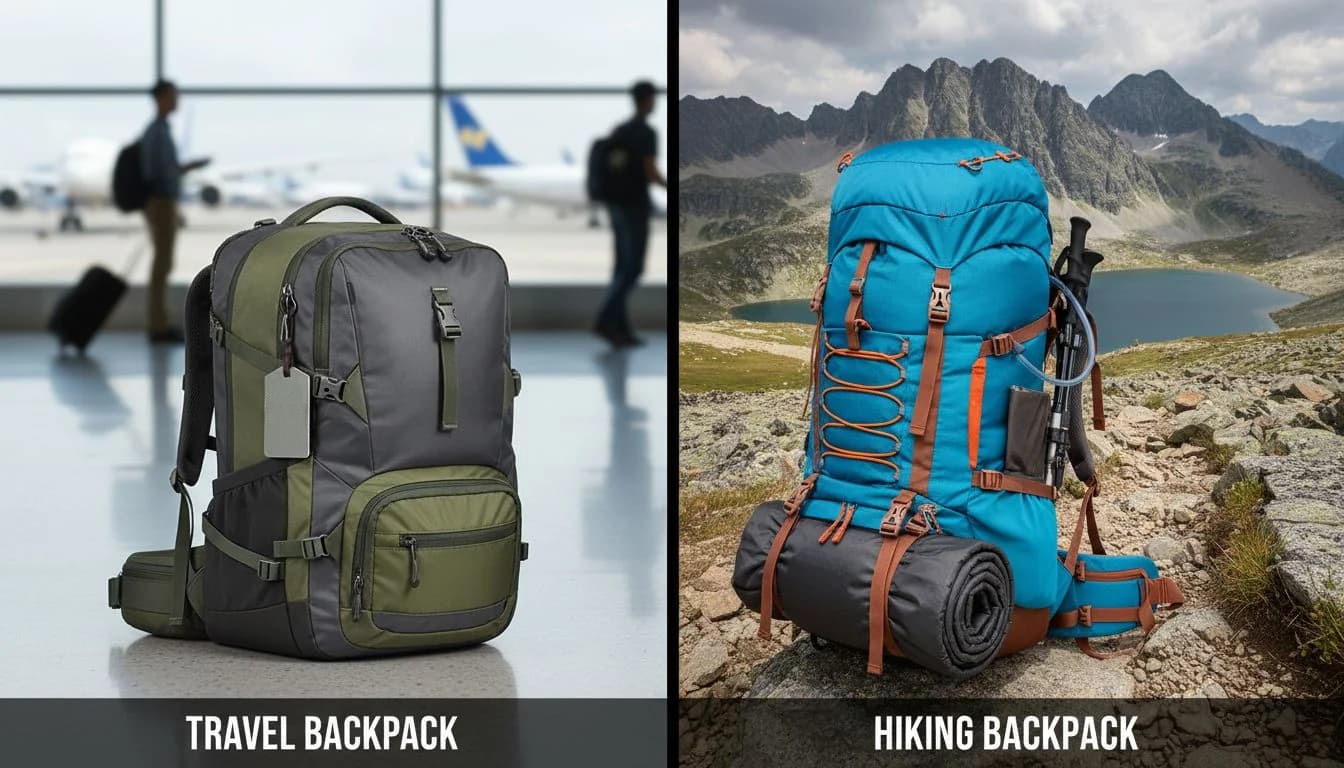
Although both travel backpacks and hiking backpacks fall under the category of functional backpacks, there are significant differences in their design priorities during product development. The former prioritizes storage and ease of use, whereas the latter requires a focus on load distribution, comfort during prolonged carrying, and performance in outdoor environments.
This positioning further determines the product's differences in structural design, material selection, functional configuration, and manufacturing processes, ultimately being reflected in the product's manufacturing cost.
1. Quick Comparison: Travel Backpacks vs. Hiking Backpacks
|
Items |
Travel Backpack |
Hiking Backpack |
|
Primary Uses |
Travel and business trips |
Hiking, mountaineering, and outdoor activities |
|
Design Highlights |
Organization and convenience |
Load carrying, carrying comfort, and outdoor performance |
|
Storage Structure |
Multiple compartments and functional pockets |
Large main compartment and gear storage space |
|
Carrying System |
Basic comfort-focused design |
Greater emphasis on load distribution and long-duration carrying |
|
Common Materials |
Polyester, nylon, RPET, etc. |
Performance-oriented materials with greater emphasis on abrasion and tear resistance |
|
Key Functions |
Laptop compartment, quick-access pockets, organized storage, etc. |
Hip belt, sternum strap, compression system, gear attachment points, etc. |
|
Manufacturing Complexity |
Mainly influenced by compartment and pocket construction |
Mainly influenced by the carrying system and reinforced structures |
|
Major Cost Factors |
Materials and storage structure |
Materials and carrying system |
The difference between the two lies not merely in appearance or capacity; their design and manufacturing are centered on different usage requirements.
2. Design Priorities of Both Backpacks
Product development should clearly define the backpack's primary usage scenarios, as these directly determine the product's design direction.
2.1 Travel Backpacks: Greater Focus on Organization and Convenience
Travel backpacks are typically designed with a focus on storage and ease of access during a trip. Since users may need to carry clothing, electronic devices, travel documents, and other personal items, the efficient organization of internal space is usually crucial. During product development, it is important to consider how different items will be organized, protected, and accessed efficiently.
2.2 Hiking Backpacks: Greater Focus on Load Carrying and Outdoor Performance
For hiking backpacks, however, greater emphasis needs to be placed on carrying performance. Depending on the specific requirements of outdoor activities, users may need to carry a significant amount of gear for extended periods and move across diverse terrains. Therefore, during the product development process, hiking backpacks typically require greater emphasis on ergonomic design, as well as the structural relationships among the main pack body, shoulder straps, back panel, and lumbar support system.
3. Differences in the Carrying System
The carrying system is one of the most important differences between travel backpacks and hiking backpacks.
3.1 Travel Backpack Carrying System
Most travel backpacks are primarily intended for daily use or relatively short periods of carrying; consequently, their carrying systems typically rely on shoulder straps and back padding to provide basic comfort. Depending on the product positioning, features such as a chest strap, breathable back panel, or luggage handle pass-through strap may also be included, though complex load-transfer systems are generally not required.
3.2 Hiking Backpack Carrying System
Hiking backpacks generally need to accommodate longer periods of carrying and heavier loads, so their carrying systems tend to be more complex.
Depending on the specific product design, the carrying system may include:
-
- Ergonomic shoulder straps
- Adjustable sternum strap
- Shoulder strap load-lifter straps
- Padded hip belt
- Internal support structure
- Ventilated back panel
- Adjustable carrying system
A well-designed hiking backpack needs to distribute the load across various supporting parts of the body as much as possible, rather than concentrating the weight primarily on the shoulders.
4. Fabric Selection
Fabric selection should be based on the product's actual performance requirements and market positioning.
4.1 Choosing Fabric for Travel Backpacks
Choosing the fabric for a travel backpack usually requires balancing appearance, durability, weight, and cost.
For example, a business travel backpack might prioritize aesthetics and protection for electronic devices, whereas a lightweight travel backpack might focus more on minimizing overall weight.
Depending on product requirements, common materials include polyester, nylon, RPET fabrics, and PU-coated fabrics.
4.2 Choosing Fabrics for Hiking Backpacks
For hiking backpacks, it is generally necessary to select fabrics with appropriate performance characteristics based on the outdoor environment in which they will be used.
Key considerations include:
-
- Abrasion and tear resistance
- Balance between strength and weight
- Weather resistance and protective performance
Depending on the product positioning, materials such as high-denier nylon, ripstop fabrics, or other highly abrasion-resistant materials may be used. When superior water resistance is required, coating options such as PU or TPU can be selected.
5. Differences in Capacity and Storage Design
Capacity alone does not fully capture the differences between the two types of backpacks; what matters more is how the internal and external spaces are configured.
5.1 Storage Design of Travel Backpacks
Travel backpacks typically enhance the efficiency of item organization through multiple functional compartments.
Common features include:
-
- Large-capacity main compartment
- Electronic device compartment
- Clothing storage section
- Front organizer pocket
- Quick-access pocket
- Hidden pocket
- Side pockets
Its core objective is to enable the organized storage of different types of items and allow users to quickly access frequently used items without fully opening the main compartment.
5.2 Storage Design of Hiking Backpacks
Hiking backpacks, on the other hand, focus more on how to efficiently carry a larger amount of outdoor gear.
Depending on the product design, features may include:
-
- High-capacity main compartment
- Top lid or top pocket
- Side pockets
- Front storage pocket
- Separate bottom compartment
- Hydration bladder sleeve
- External gear attachment points
Its spatial design typically requires consideration of specific outdoor gear. Items that cannot easily fit into the main compartment may be carried using external webbing, attachment loops, or other securing mechanisms.
6. Manufacturing Complexity and Production Requirements
The sources of manufacturing complexity for travel backpacks and hiking backpacks differ.
The complexity of travel backpacks stems primarily from their storage design; consequently, product complexity is mainly reflected in the number of panels, the assembly of various components, and the stitching processes for pockets and compartments.
The complexity of hiking backpacks stems largely from their carrying systems and structural reinforcement. During the production process, certain critical load-bearing areas may require additional reinforcing stitching. Furthermore, carrying systems typically consist of multiple components; such products generally demand higher standards for prototyping, component assembly, and production consistency.
7. What Are the Main Differences in Manufacturing Costs?
Hiking backpacks are not necessarily more expensive than travel backpacks; the latter can also incur high manufacturing costs due to complex construction and high-end materials.
7.1 Key Factors Affecting the Manufacturing Cost of Travel Backpacks
-
- Fabrics and accessories
- Structural and functional design
- Hardware specifications
- Custom branding details
- Order quantity
For example, there is a significant difference in manufacturing costs between a travel backpack made from standard materials with a simple design and a business travel backpack featuring multiple independent compartments, a laptop protection system, and high-quality hardware.
7.2 Key Factors Affecting the Manufacturing Cost of Hiking Backpacks
-
- Functional fabrics
- Carrying system and structural design
- Reinforcement and accessory specifications
- Stitching and assembly techniques
- Order quantity
Complex carrying systems, performance-oriented materials, and reinforcement at multiple points all increase material and labor costs.
Therefore, when comparing the purchase prices of travel backpacks and hiking backpacks, one should not judge solely based on product category; instead, the assessment should take into account specific factors such as materials, construction, and functional features.
Conclusion
Travel backpacks and hiking backpacks do not necessarily need to evolve along two completely separate product paths. As consumer usage scenarios continue to evolve, an increasing number of brands are attempting to combine the organizational convenience of travel backpacks with the carrying performance of outdoor packs. This type of hybrid design opens up new possibilities for brands to develop differentiated products for niche markets. For brands, this means that the scope for backpack development is not confined to traditional categories; instead, they can create more targeted products by combining various functions.
Related Reading
Table of Contents
- Introduction
- 1. Quick Comparison: Travel Backpacks vs. Hiking Backpacks
- 2. Design Priorities of Both Backpacks
- 3. Differences in the Carrying System
- 4. Fabric Selection
- 5. Differences in Capacity and Storage Design
- 6. Manufacturing Complexity and Production Requirements
- 7. What Are the Main Differences in Manufacturing Costs?
- Conclusion