 EN
EN


Introduction
Handbags are one of the most important product categories in the global bag market. According to Mordor Intelligence, handbags accounted for 40.81% of the global bags market in 2025, representing the largest market share among all bag categories.
In terms of the consumer base, female consumers hold an absolutely dominant position in the handbag market. In 2025, female consumers accounted for 89.14% of the global handbag market, further highlighting the importance of women's handbags within the market as a whole.
For brands and buyers, understanding the product characteristics, usage scenarios, and market trends associated with different types of women's handbags helps optimize product planning, assortment selection, and market positioning.
1. Tote Bags
1.1 What is a Tote Bag?
Tote bags typically feature a spacious main compartment and two handles, allowing them to be carried by hand or worn over the shoulder. Depending on the product's intended use, they can range from simple, open-top canvas bags to structured leather business bags equipped with zippers, internal dividers, and supportive framing.
1.2 Market Position: The Largest Product Category in the Global Handbag Market
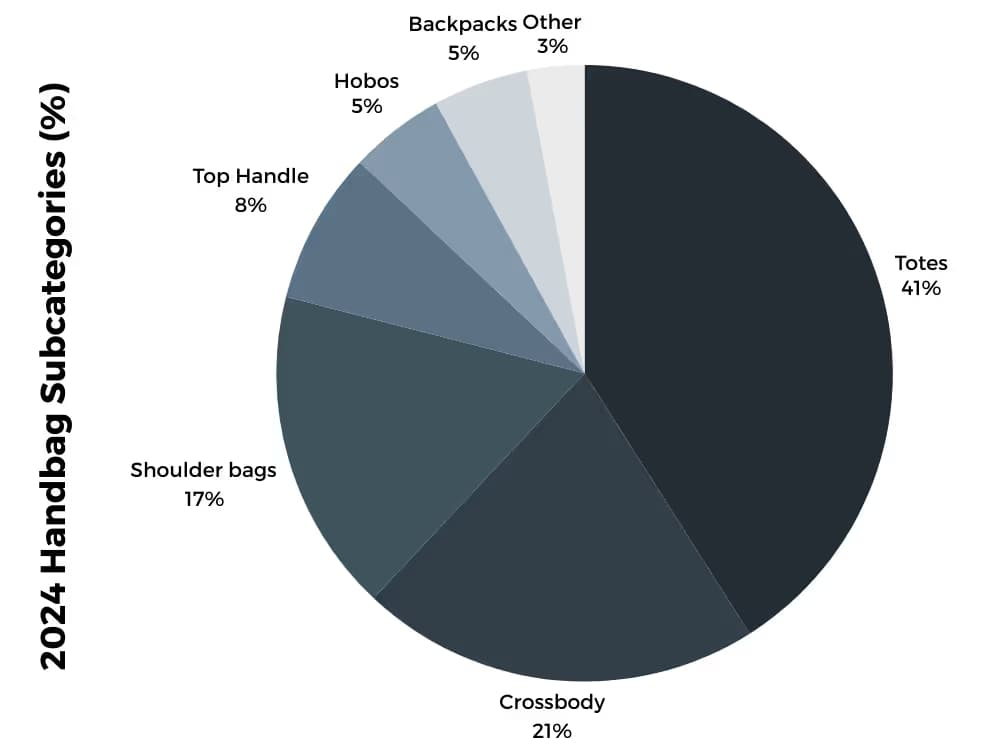
According to data from JOOR, tote bags accounted for 41% of the global handbag market in 2024, making them the largest product category by market share. Their primary advantage lies in their versatility; a well-designed tote can meet a wide range of daily needs—such as commuting, casual shopping, and short trips—without requiring any changes to the product's fundamental structure.
1.3 Common Material Choices
Different materials directly affect product positioning. Genuine leather and structured synthetic leather can create a more refined or premium appearance, while canvas is better suited to casual styles. Nylon and polyester are commonly used for lightweight and functional products.
1.4 Key Product Development Considerations
During the development process of the tote bag, special attention needs to be paid to the following issues:
-
- Handle Strength: The method of attaching the handle to the bag body must be commensurate with the product's intended load-bearing capacity.
- Bottom Reinforcement: Large-capacity products typically require adequate bottom support to minimize deformation.
- Shape Retention: For designs requiring a crisp, structured look, the addition of interlining or internal support materials may be necessary.
2. Crossbody Bags
2.1 What is a Crossbody Bag?
Crossbody bags typically feature a long, adjustable strap that allows the bag to be worn diagonally across the body from one shoulder to the opposite side. Common styles include small camera bags, flap bags, and saddle bags.
2.2 Market Position: An important Category of Hands-free Everyday Handbags
In 2024, crossbody bags accounted for 21% of handbag category sales, making them one of the leading handbag types, second only to tote bags. The key advantages of crossbody bags are their portability, style, and versatility. Their compact designs and adjustable straps make them suitable for a wide range of occasions, including everyday use, shopping, travel, and leisure activities.
2.3 Capacity and Dimension Planning
The size of a crossbody bag should be determined based on intended usage scenarios and actual carrying needs; a bag that is too small compromises practicality, while one that is excessively large or heavy may reduce stability and comfort when worn across the body.
Therefore, prior to product development, it is essential to identify the primary items target users carry and strike a balance between storage capacity and carrying comfort.
2.4 Key Product Development Considerations
The design of a crossbody bag focuses on practical aspects such as wearing comfort, ease of access to contents, and long-term reliability.
The shoulder strap is one of the key components affecting the user experience and should be carefully designed in terms of its adjustable length range, width, thickness, and attachment points to the bag body. The internal layout should be partitioned according to the items to be stored, avoiding the creation of wasted space in an attempt to increase capacity.
In addition, factors such as the weight of the bag, the strength of the hardware, and the reinforcement of stress points must also be considered concurrently during the development phase.
3. Shoulder Bags
3.1 What is a Shoulder Bag?
The defining characteristic of a shoulder bag is the way it is carried—slung over one shoulder using a relatively short strap. Structured flap bags, soft under-the-arm bags, and stylish handbags with chain straps all fall under the category of shoulder bags, yet their market positioning may differ vastly.
3.2 Market Position: Key Category for Everyday and Fashion Handbags
In 2024, shoulder bags accounted for 17% of sales within the handbag category. Shoulder bags strike an effective balance between everyday practicality and stylish design; brands can differentiate their offerings through variations in bag shape, materials, hardware, and seasonal styling to cater to diverse consumption scenarios and aesthetic preferences.
3.3 Common Material Choices
There is a wide range of material options for shoulder bags. Genuine leather and PU leather are commonly used for fashion-oriented and mid-to-high-end products to highlight texture and appearance, whereas nylon, polyester, and canvas are better suited for lightweight, casual, and functional shoulder bags.
Common auxiliary materials also include polyester or nylon linings, EPE/EVA/PE foam padding, and hardware fittings made of zinc alloy, aluminum alloy, or iron.
3.4 Key Product Development Considerations
The following details will directly affect the product experience:
-
- Shoulder Strap Drop: The distance between the shoulder strap and the body of the bag should ensure the product can be carried comfortably on the shoulder.
- Overall Weight: Excessive product weight reduces comfort for the shoulders and back.
- Ease of Access: Users should be able to conveniently retrieve or stow items while carrying the bag on their shoulder.
- Bag Structure: Structured and soft constructions can create distinctly different product styles.
4. Top Handle Bags
4.1 What is a Top Handle Bag?
Top handle bags typically feature one or two short handles at the top of the bag, designed primarily for carrying by hand or over the forearm. Many modern top handle bags also include a detachable long shoulder strap for greater carrying versatility.
4.2 Market Position: A product Category Emphasizing Structural Definition and Refined Appearance
In 2024, top handle bags accounted for 8% of sales within the handbag category. Top handle bags are typically characterized by their structured silhouettes, defined forms, and hand-held designs. Emphasizing refinement and visual quality, they are frequently featured in business, professional, and premium fashion handbag collections.
4.3 Manufacturing Complexity and Cost Factors
The primary manufacturing difference between top-handle bags and soft-style handbags lies in the need for the bag body to maintain a stable, structured silhouette. Achieving this crisp, defined shape typically requires the incorporation of stiffening panels, foam, or other support materials, alongside specific construction techniques to ensure uniformity across all surfaces.
This type of structured design increases the number of material layers and production steps, while also imposing stricter manufacturing requirements; consequently, in addition to material costs, the associated labor and quality control requirements are significant factors influencing the cost of top handle bags.
4.4 Key Product Development Considerations
Beyond the previously mentioned body structure and molding requirements, the design and development of handbags should also focus on handle durability, the opening and closing mechanism, and ease of use.
The handle is the primary load-bearing component of a top handle bag, so its length, carrying comfort, attachment method, and reinforcement structure should be designed to match the weight of the bag. In addition, the opening and closure, internal organization, and shoulder strap configuration (if applicable) should be planned according to the target use case to enhance functionality and user experience while maintaining the intended appearance.
5. Hobo Bags
5.1 What is a hobo bag?
Hobo bags typically feature a soft body and a curved or crescent-shaped silhouette, accompanied by a shoulder strap. When carried, the bag usually takes on a natural, slouchy drape.
5.2 Market Position: A product Category Centered on Soft Silhouettes and Fashionable Appeal
In 2024, hobo bags accounted for 5% of handbag category sales. The defining characteristics of hobo bags lie not in complex internal functionality, but in their soft structure, natural slouchy silhouette, and effortless style—typically carried over the shoulder or tucked under the arm—striking a balance between everyday practicality and fashion appeal.
Given that the appearance and silhouette of hobo bags are susceptible to shifting trends, they are better suited as fashion-forward or style-driven pieces rather than as enduring, reliable wardrobe staples.
5.3 Key Product Development Considerations
The structural development of hobo bags focuses on maintaining a soft, naturally draping silhouette while ensuring sufficient strength and durability in key stress-bearing areas.
The connection point of the shoulder strap is a primary load-bearing area; it requires appropriate reinforcement based on the bag's dimensions and expected load to prevent deformation or damage over prolonged use. Meanwhile, the design of the bag opening must balance ease of access with a soft, natural appearance, avoiding excessive rigid structures that could compromise the bag's overall drape.
How to Choose the Right Handbag Type for Your Brand
When selecting a type of women's handbag, one should not rely solely on market share or growth trends; instead, the decision should take into account target consumers, usage scenarios, price positioning, and the overall product strategy.
-
- Start with the Target Use Case
First, it is essential to clarify the product's primary usage scenarios, as these directly influence its dimensions, capacity, storage configuration, material selection, and overall design. For example, products designed for commuting typically prioritize capacity and practicality, whereas those intended for fashion or formal occasions place greater emphasis on appearance, materials, and a sense of refinement.
-
- Define the Price Point and Product Positioning
The same bag style can correspond to vastly different market positionings and cost structures.
For instance, a tote bag can feature a simple canvas construction aimed at the mass market, or it can utilize genuine leather, complex internal compartments, and high-quality hardware to target the mid-to-high-end market. Therefore, while determining the bag style, it is also necessary to define the target price range, material standards, and craftsmanship requirements for the product.
-
- Build a Balanced Product Mix of Core and Fashion-Driven Styles
For most brands, the product portfolio should not rely entirely on a single category; instead, it should strike a balance between core products that generate steady sales and differentiated products with fashionable appeal.
This combination approach covers relatively stable daily needs while enriching the brand's style through trendy products and creating room for the development of seasonal new items.
Conclusion
Different types of women's handbags cater to different market demands. Products such as tote bags, crossbody bags, and shoulder bags generally cater to broad everyday needs; in contrast, items like hobo bags and top handle bags place greater emphasis on fashion appeal and product differentiation, while clutches and evening bags are primarily designed for specific occasions.
For brands and buyers, selecting a handbag type is not simply a matter of choosing the product with the largest market share; more importantly, it requires a comprehensive assessment aligned with the overall product strategy. Only by evaluating from the perspectives of both market demand and product development can one establish a women's handbag product portfolio that meets consumer needs while also featuring clear product positioning and supply chain feasibility.
Related Reading