 EN
EN


Introduction
The competitiveness of global travel backpack manufacturers depends not only on brand recognition but also on comprehensive capabilities spanning product R&D, manufacturing scale, supply chain management, quality control, and global market experience.
Based on the aforementioned criteria, this article categorizes the world's leading travel backpack companies into three groups:
-
- Global bag enterprises: These companies possess global market influence and have built up mature product portfolios, supply chain management capabilities, and international operational experience over the long term.
- Specialized travel backpack manufacturers: These companies focus on the travel backpack sector and possess distinct advantages in product design, functional development, and user experience.
- Large-scale OEM/ODM manufacturers: These enterprises primarily serve global brands and buyers, with core competencies lying in large-scale production, rapid development, and supply chain support capabilities.
1. Global Bag Enterprise
1.1 Samsonite
Country and Year Established: Global, established in 1910.
Reason for Inclusion: A leading global enterprise in the travel goods industry, possessing a mature product R&D system, global supply chain management capabilities, and influence in international markets.
Key Advantages:
-
- Global Brand and Market System: Samsonite owns a portfolio of international travel brands, including Samsonite (positioned in the mid-to-high-end travel goods market), TUMI (targeting high-end business travelers), and American Tourister (catering to younger travelers), with operations spanning consumer markets in North America, Europe, and Asia.
- Mature Supply Chain Management Capabilities: Samsonite does not rely on a single production base; instead, it supports the demands of different markets through a global supply chain network.
- Continuous Product R&D and Innovation Capabilities: Samsonite consistently invests in areas such as lightweight design, product structural optimization, and enhanced protective performance, continually refining the functionality and user experience of its travel products. Its product range encompasses suitcases, travel bags, business bags, and leisure travel accessories.
1.2 VF Corporation
Country and Year Established: United States, established in 1899.
Reason for Inclusion: The product R&D and supply chain integration capabilities of global outdoor brand group.
Key Advantages:
-
- Global Brand and Market System: VF Corporation is a renowned global outdoor apparel and footwear group. Its portfolio includes brands such as The North Face, Vans, and Timberland, forming a brand lineup and operational system that spans global markets.
- Global Supply Chain Management Experience: VF has long-standing experience in operating global consumer brands, possessing mature expertise in supplier management and global production footprint.
- Outdoor Product R&D Capabilities: The company's outdoor brand portfolio encompasses hiking backpacks, mountaineering gear, and adventure travel equipment, with products emphasizing functionality, durability, and outdoor performance.
- International Brand Standards: Serving the global consumer market requires the supply chain system to meet rigorous product quality requirements and international market standards.
1.3 Thule Group
Country and Year Established: Sweden, established in 1942.
Reason for Inclusion: A leading global outdoor travel equipment company, possessing a mature product R&D system and global supply chain capabilities.
Key Advantages:
-
- A Product Ecosystem Spanning Diverse Outdoor Travel Scenarios: Compared to traditional backpack brands, Thule’s competitive advantage stems not from individual products alone, but from a comprehensive product ecosystem built around "outdoor mobility scenarios"—encompassing hiking, cycling, photography, business travel, and more.
- Proven Product R&D and Design Capabilities: Thule has long prioritized functional design and product reliability, continuously investing in areas such as ergonomic design, structural optimization, and material durability to enhance product performance across diverse usage scenarios.
- Global Market and Supply Chain Operational Capabilities: Thule’s products are sold in international markets across Europe, North America, and Asia, enabling the company to establish mature product development processes, supply chain management systems, and global sales channels.
1.4 Victorinox
Country and Year Established: Switzerland, established in 1884.
Reason for Inclusion: A global travel goods brand with a mature product design system and experience in the high-end market.
Key Advantages:
-
- Diverse Travel Gear Product Portfolio: Victorinox has developed a comprehensive product lineup centered on travel scenarios—including luggage, travel bags, business bags, and travel accessories—with a strong emphasis on reliable performance during long-term use.
- Global Brand and Channel Capabilities: Victorinox products have entered numerous international markets. Its well-established global sales system has enabled the company to gain a deep understanding of international consumer needs and extensive experience in market operations.
- Functional Product Design Capabilities: Victorinox has long upheld the "Swiss Made" philosophy, prioritizing product functionality and the refinement of details. Its design focus encompasses optimizing space utilization, enhancing product durability, and tailoring products to business travel scenarios. These design principles help the brand maintain its competitiveness in the mid-to-high-end travel goods market.
2. Professional Travel Backpack Manufacturer
2.1 Deuter
Country and Year Established: Germany, established in 1898.
Reason for Inclusion: A representative company in the European professional outdoor backpack sector, possessing long-standing R&D capabilities in carrying systems.
Key Advantages:
-
- Expertise in Carrying System R&D: Deuter has long focused its product development on ergonomics, prioritizing the optimization of technologies such as back support structures, weight distribution designs, and ventilation performance. Among these features, the Aircomfort carrying system is a key technological highlight of Deuter; it optimizes the structure for airflow across the back, thereby reducing discomfort during prolonged use.
- Extensive Experience in Outdoor Product Development: Tailoring designs to diverse outdoor scenarios, Deuter continuously optimizes details such as capacity, functional compartmentalization, and material selection to ensure its products are better suited for the demands of prolonged outdoor use.
- Recognition in the European Outdoor Market: Deuter has cultivated the European outdoor market for years, building a strong reputation among professional users—such as hikers and mountaineers—while its long-standing product portfolio and consistent quality have further solidified the brand's influence in the professional outdoor backpack sector.
2.2 Osprey
Country and Year Established: United States, established in 1974.
Reason for Inclusion: A representative company in the high-end outdoor travel backpack sector, possessing leading capabilities in carrying system R&D and product innovation.
Key Advantages:
-
- Industry-leading Suspension System R&D Capabilities: Osprey has long focused on the research and development of backpack structures and suspension systems. By designing for diverse body types and usage scenarios—and optimizing weight distribution, back support, and adjustability—the brand enhances comfort during prolonged carrying
- Extensive Experience in Professional Outdoor Product Development: Osprey’s product range spans categories such as hiking, mountaineering, and travel backpacks, meeting diverse needs ranging from short excursions to long-distance journeys.
- Recognition in the High-end Outdoor Market: Leveraging years of expertise in outdoor products, Osprey has earned widespread recognition among outdoor enthusiasts worldwide, establishing itself as a leading brand in the field of high-performance outdoor travel backpacks.
3. Large-scale OEM/ODM Manufacturer
3.1 HPHope
Country and Year Established: China, established in 2010.
Reasons for Inclusion: Dual-Region Manufacturing Layout and Global bag Supply Chain Service Capabilities.
Key Advantages:
-
- Dual Production Bases in China and Vietnam Enhance Supply Chain Stability: Through this dual-base setup, HPhope offers customers greater flexibility in production options, effectively mitigating the risk of relying on a single region—such as exposure to changes in international trade policies or cost fluctuations.
- Integrated Capabilities Spanning Product Development to Mass Production: Through deep synergy between product development and manufacturing, HPhope provides customers with comprehensive support—ranging from design optimization and prototype development to mass production—thereby helping buyers reduce project development risks and accelerate time-to-market.
- Large-scale Manufacturing and International Order Fulfillment Capabilities: HPhope employs over 1,500 staff and operates multiple bag production lines, possessing the capacity to simultaneously handle orders for diverse product categories and large volumes. With exports reaching more than 90 countries, the company meets the requirements of clients across various markets regarding product quality, delivery timelines, and supply chain stability.
- Experience with International Quality Systems and Customer Audits: HPhope has successfully undergone international audits such as BSCI and Sedex and has established quality management processes—spanning material inspection, production process control, and finished product testing—to support long-term partnerships with international clients.
3.2 Youngone Corporation
Country and Year Established: South Korea, established in 1974.
Reason for Inclusion: Global outdoor product manufacturing and supply chain service capabilities.
Key Advantages:
-
- Global Production Footprint: Youngone operates manufacturing bases across multiple Asian countries—including Vietnam, Bangladesh, and China—enabling the company to enhance supply chain stability and meet the diverse market demands of international clients.
- Experience in Outdoor Product Manufacturing: Long-standing service to the outdoor gear market has enabled Youngone to accumulate extensive experience in manufacturing functional products. Its manufacturing capabilities cover travel backpacks, mountaineering equipment, and functional apparel. The company has extensive experience in material application, complex manufacturing processes, and translating functional designs into production.
- Experience in the Supply Chains of International Brands: Youngone has long been a participant in the global outdoor industry supply chain; its strengths lie not only in production scale but, more importantly, in the implementation of international quality standards and the capability to manufacture complex products.
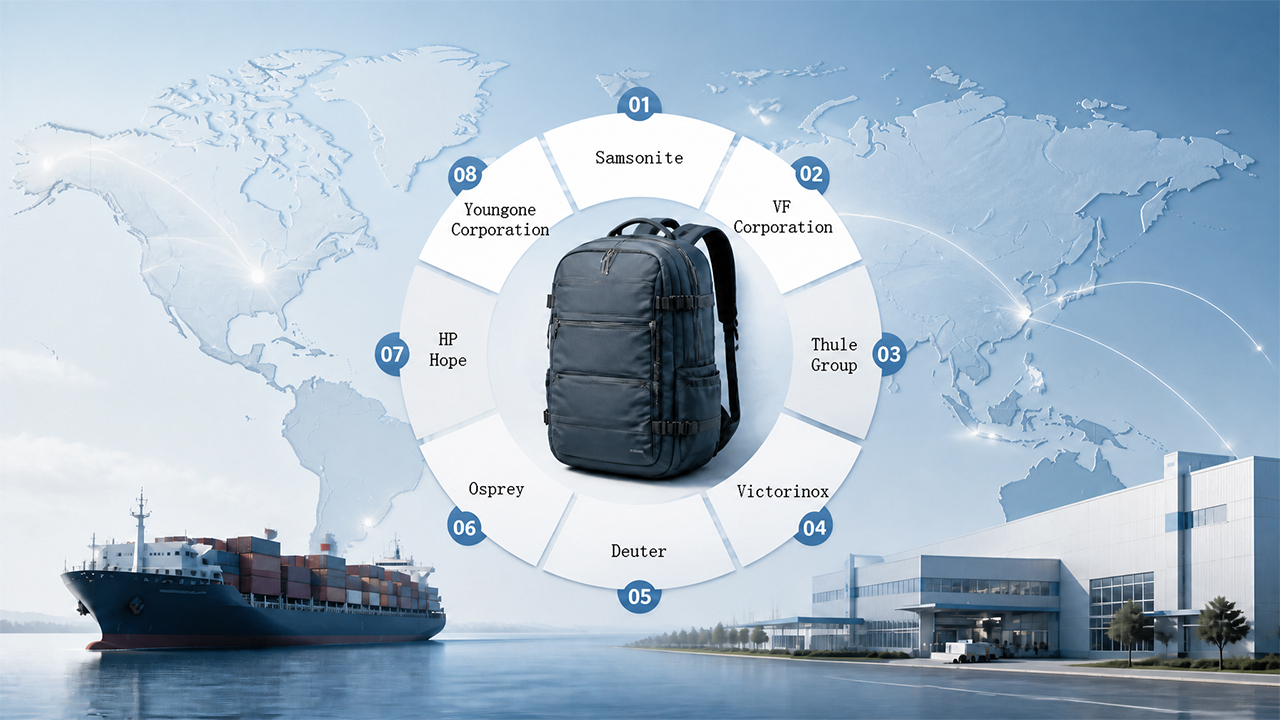
A Comparison of the World's Top 8 Travel Backpack Manufacturers
-
- Samsonite: Global travel product brand portfolio and supply chain management capabilities.
- VF: Global outdoor brand portfolio and supply chain integration capabilities.
- Thule Group: R&D capabilities for functional outdoor travel gear.
- Victorinox: High-end travel gear brand and product design capabilities.
- Deuter: Professional outdoor backpack R&D and suspension system technology.
- Osprey: Innovation and User Experience Design for High-Performance Travel Backpacks.
- HPhope: Global bag supply chain service capabilities.
- Youngone: Global outdoor product manufacturing and supply chain service capabilities.
Conclusion
From global brands and specialized outdoor backpack companies to OEM/ODM manufacturers, various types of enterprises are leveraging their respective strengths to compete in the global travel backpack industry. In the future, companies capable of continuously adapting to shifting global market demands while striking a balance between product innovation and supply chain efficiency will be better positioned to maintain a long-term competitive advantage in the travel backpack industry.
Related Reading
1. Travel Backpack vs Hiking Backpack: Key Differences in Design and Manufacturing