 EN
EN


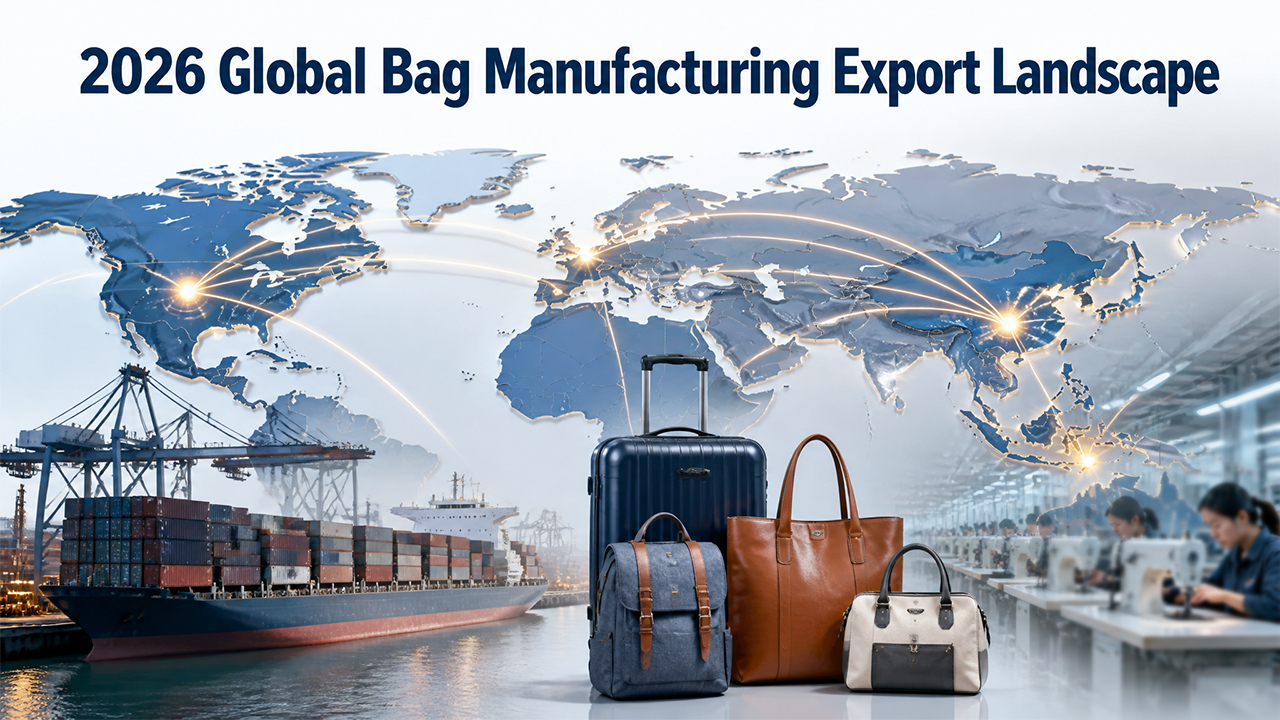
1. Introduction
For a long time, bag procurement has lacked a clear understanding of the differences between various production regions—such as supply chain completeness, product development capabilities, manufacturing capabilities, and trade policies. As global supply chains continue to adjust, a more diversified competitive landscape is emerging among bag production bases. This article focuses on major bag manufacturing countries with large-scale export capabilities, analyzing the industrial strengths and future development trends of each region.
2. Overview of the Global Bag Export Industry Landscape
Based on production capacity, manufacturing sophistication, and market positioning, global bag export hubs can be clearly categorized into four tiers:
-
- Tier 1: China — The World’s Largest Bag Export Hub, Offering Comprehensive Product Coverage and Full Manufacturing Capabilities.
- Tier 2: Vietnam — A Standardized Manufacturing Base for International Brands.
- Tier 3: India — A Major Global Leather Bag Manufacturing Country; Cambodia and Bangladesh — Emerging Low-Cost Manufacturing Bases.
- Specialized High-End Hub: Italy — A Leader in Luxury Leather Bag Manufacturing.
3. In-Depth Analysis of Key Global Bag Exporting Countries
3.1 China
Export Volume: In 2025, China’s bag exports reached USD 29.95 billion, maintaining its position as the world’s largest bag exporter.
Key Export Categories: Handbags, luggage, crossbody bags, and backpacks collectively account for 81% of the total export value, with handbags representing the largest share at approximately 46%.
Core Competitive Advantage: China has the world’s most complete bag supply chain system, with highly integrated capabilities covering everything from raw materials to finished product manufacturing. Possessing robust OEM/ODM manufacturing capabilities, China has accumulated extensive product expertise and established a mature quality management system through years of serving global clients, thereby fostering the development of numerous mature bag production bases.
Applicable Orders: Procurement projects demanding high standards in R&D capabilities, supply chain integration, and quality control, as well as innovative bag products utilizing recycled materials, functional fabrics, and specialized manufacturing processes.
Key Export Markets: the EU, the United States, Japan, ASEAN, Latin America, etc.
Challenges: Some overseas markets have raised import tariffs or imposed trade restrictions, increasing export costs and the pressure of market expansion for Chinese bag enterprises. Additionally, Southeast Asian bag manufacturing hubs are creating more intense competition in basic and standard product segments by leveraging their cost advantages.
3.2 Vietnam
Export Volume: In 2025, Vietnam's bag exports reached approximately US$4 billion, making it the world's second-largest export hub.
Key Export Categories: Handbags, luggage, briefcases, etc.
Core Competitive Advantage: Leveraging free trade agreements such as the CPTPP and EVFTA, Vietnam enjoys tariff preferences in select European and American markets. A large number of foreign-invested companies have established operations in the region, contributing to the development of a relatively mature large-scale manufacturing system.
Applicable Orders: Large, long-term orders for established brands—characterized by high standardization and mature production processes—are particularly well-suited for projects targeting European and American markets that aim to leverage trade agreements to reduce import tariff costs.
Key Export Markets: The United States, the EU, the United Kingdom, Canada, etc.
Challenges: The domestic upstream and downstream supply chain is incomplete, with a heavy reliance on imports for fabrics and accessories. Additionally, there remains a gap compared to China in product R&D and sample development capabilities, and there is a lack of capacity for manufacturing complex bags involving multiple processing steps. Furthermore, quality control standards among small and medium-sized workshops vary widely.
3.3 India
Export Volume: In 2025, India's bag exports reached approximately US$1.6 billion.
Key Export Categories: Leather goods such as genuine leather handbags and wallets.
Core Competitive Advantage: Possessing abundant leather resources and a mature leather processing infrastructure, India holds traditional strengths in the sectors of genuine leather bags and handcrafted manufacturing.
Applicable Orders: Genuine leather handbags, small leather goods, distinctive handcrafted bags, small-to-medium batch casual bags, and price-sensitive bag orders.
Key Export Markets: The United States, the EU, the Middle East, etc.
Challenges: The supporting bag supply chain remains underdeveloped, while infrastructure limitations restrict the ability to manufacture complex products at large scale. Furthermore, overall quality control standards are relatively low, and the capacity to handle orders from high-end brands is limited.
3.4 Cambodia and Bangladesh
Export Volume: In 2025, both Bangladesh and Cambodia recorded bag export values at the scale of several hundred million US dollars.
Key Export Categories: Travel bags, basic backpacks, canvas bags, promotional gift bags, etc.
Core Competitive Advantage: Cambodia and Bangladesh benefit from significant labor cost advantages, supported by their mature garment manufacturing ecosystems and strong sewing and processing capabilities. Meanwhile, the expansion of global brand supply chains is driving the development of their local bag manufacturing industries.
Applicable Orders: Low- to mid-range bag products with a high degree of standardization.
Key Export Markets: Western markets, such as the United States and the EU.
Challenges: The upstream and downstream supply chain for the bag industry remains incomplete, with key fabrics, accessories, and certain production equipment still dependent on imports. Product development capabilities and expertise in complex bag manufacturing remain relatively limited, resulting in lower competitiveness in high-end and functional bag segments.
3.5 Italy
Export Volume: In 2024, Italy’s bag exports were valued at approximately USD 9 billion, with 2025 figures expected to remain at a similar level.
Key Export Categories: Genuine leather luxury handbags, high-end fashion leather goods, and handcrafted affordable luxury bags.
Core Competitive Advantage: Carrying on a legacy of refined, handcrafted genuine leather artistry, the "Made in Italy" label commands a significant brand premium and serves as a core global hub for the supply of luxury bags.
Applicable Orders: Finished products from high-end luxury brands and custom orders for limited-edition handcrafted leather goods.
Key Export Markets: High-end consumer markets such as France, the United States, Germany, Switzerland, China, and Japan.
Challenges: Production costs are relatively high. The traditional manual manufacturing model limits the capacity for large-scale expansion, resulting in limited competitiveness regarding standardized, high-volume orders. The enhanced mid-to-high-end bag manufacturing capabilities of countries such as China and Vietnam are exerting competitive pressure on certain segments of the market.
4. Global Bag Export Industry Development Trends
4.1 The tiered relocation of supply chains is becoming the norm, and the "China Plus One" model continues to gain widespread adoption.
An increasing number of international buyers are adopting a "China + Southeast Asia" dual-base model to mitigate geopolitical and tariff risks. Production capacity for standardized, low-complexity goods continues to shift toward Vietnam, Cambodia, India, and Bangladesh, while orders involving complex structures, deep customization, and stringent compliance requirements will continue to rely on China’s mature industrial supply chain ecosystem.
4.2 Environmental compliance capability has become a new competitive threshold for bag suppliers.
As global market demands for sustainability continue to rise, environmental standards—such as the EU's carbon tariff, the REACH chemicals regulation, and GRS certification for recycled materials—are accelerating changes in the landscape of the luggage and bag supply chain. In the future, mere production capability will no longer suffice to meet international procurement demands; suppliers will also need to provide material solutions that meet environmental standards and proof of compliance.
4.3 Bag product categories continue to evolve and upgrade.
The export growth rates of outdoor functional bags, lightweight travel bags, and bags made from recycled eco-friendly fabrics continue to outpace those of traditional fashionable women's handbags. As global consumer demand for the functionality and durability of bags continues to rise, manufacturing plants are compelled to constantly upgrade their craftsmanship and material solutions, while the growth potential for low-end products continues to shrink.
4.4 The market space for a business model based purely on low-price competition continues to shrink.
As low-cost manufacturing capabilities in regions such as Southeast Asia continue to improve, price competition for standardized, low-value-added luggage products is becoming increasingly intense. Manufacturing enterprises that rely solely on low prices to secure orders face pressure from shrinking profit margins and the loss of orders, and the industry is undergoing rapid differentiation: Enterprises possessing R&D capabilities and supply chain advantages are gradually upgrading toward functional, differentiated, and customized products, whereas low-end production capacity lacking core competitiveness faces the risk of elimination.
5. Conclusion
The global bag export industry has settled into a stable, stratified structure, with no single country standing out as the absolute best for production. The most suitable manufacturing base is determined by a combination of factors: the technical complexity of the orders, the target sales markets, and compliance requirements.
China’s core positioning is as a primary export hub for complex, mid-to-high-end luggage and bags; Southeast Asian production centers leverage tariff advantages to handle standardized contract manufacturing; Cambodia and Bangladesh firmly dominate the market for low-end, simple bags; and Italy retains its hold on the pinnacle of the global luxury luggage and bag market.
For global buyers and bag manufacturers, recognizing the operational limits of different production regions—and adopting strategies such as differentiated competition, a multi-base layout, and a shift toward high-value-added products—serves as a long-term approach to navigating shifts in global supply chains.
Related Reading