 EN
EN


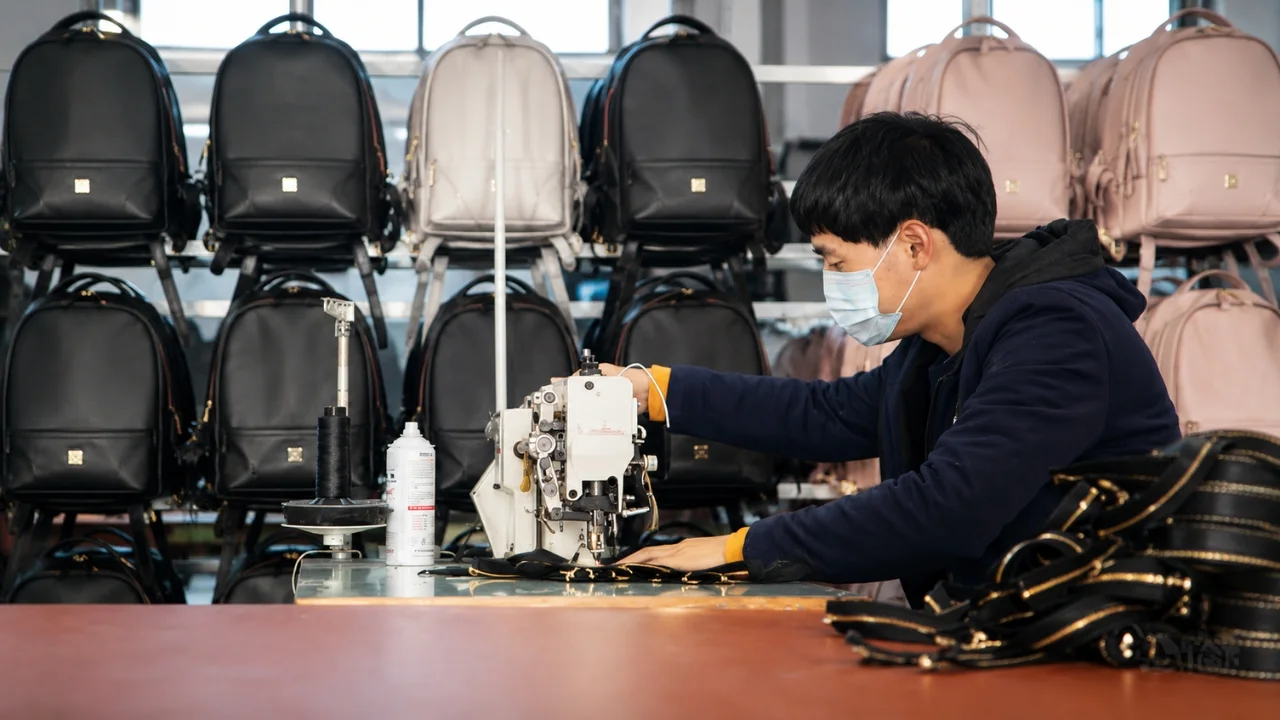
In 2025, China's exports of luggage and bags exhibited a distinct pattern of rising volumes alongside falling prices: Export volume maintained steady growth, while export value and average unit prices declined year on year, indicating that the industry is shifting from scale expansion toward value-driven competition.
1. Key Data on China’ s Bags and Luggage Exports in 2025
According to data from the General Administration of Customs of China:
-
- Total volume of China's luggage and bag exports in 2025: 3.682 million tonnes, up 1.6% year-on-year.
- Total value of China's luggage and bag exports in 2025: 213.99 billion yuan (29.95 billion USD), down 12.9% year-on-year.
- Average export price of Chinese luggage and bags in 2025: 58,100 yuan/tonne (8,126 USD/tonne), down 14.3% year-on-year.
Export volumes have maintained modest growth, indicating that global market demand for Chinese luggage and bags remains stable and that the "Made in China" supply chain continues to possess strong competitiveness.
However, the significant decline in export value and average export prices also reflects the pressure the industry faces from intensifying price competition and the need to adjust its product mix. The past model of securing orders through low costs and large-scale production is shifting; going forward, luggage and bag manufacturers must establish new competitive advantages through product innovation, supply chain optimization, and quality enhancement.
2. Structure of China's Luggage and Bag Exports in 2025
The structure of China's luggage and bag exports is further diverging, with distinct differences in the development trends of various trade modes.
2.1 General Trade (The Dominant Trade Mode)
Total exports for the year amounted to 2.71 million tonnes; while export volume rose by 0.1% year-on-year, export value fell by 17.3%.
General trade remains the dominant export mode for China’s bags and luggage industry, accounting for 73.6% of total exports. This model reflects a supply chain structure where domestic enterprises independently source raw materials, develop and design products, and directly compete in global markets. This trade mode covers a large number of OEM/ODM projects, mid-to-high-end functional bags, and orders from brand customers.
Driven by increasing procurement price pressures and intensified industry competition, general trade export value experienced a notable decline, further putting pressure on corporate profit margins.
2.2 Processing Trade
Total annual exports amounted to approximately 30,000 tonnes; export volume fell by 23.6% year-on-year, and export value declined by 16.5% year-on-year.
Traditional processing trade primarily relies on models such as processing with supplied materials and processing with imported materials. In recent years, driven by adjustments to global supply chains, orders of this type have gradually shifted to low-cost production regions such as Southeast Asia.
Processing trade accounts for less than 1% of China's luggage and bag exports; its decline has a limited impact on the overall export volume.
2.3 Other Trade
Total annual exports amounted to approximately 830,000 tonnes, accounting for 22.5% of the total; export volume increased by 9.0% year-on-year, marking it as a channel with significant export growth among the various trade modes in 2025. However, the value of exports fell by 1.2% year-on-year, exhibiting a distinct pattern of "rising volume but falling prices."
Compared with general trade, other trade modes showed stronger growth resilience in 2025, with rising export volumes reflecting the continued diversification of global market demand.
In terms of changes in export value, growth in this channel stems primarily from an increase in export volume rather than a rise in product value, meaning it faces the same predicament as general trade.
Data Source: General Administration of Customs of China
3. Trends in China’s Bags and Luggage Industry Clusters
In 2025, China's luggage and bag industry clusters are exhibiting increasingly distinct paths of differentiated development. Leveraging their respective strengths in industrial foundations, product positioning, and customer structures, different regions have gradually established a pattern of differentiated competition.
3.1 Guangdong Luggage and Bag Industry Clusters (Guangzhou, Dongguan): Upgrading towards high-value-added customization and brand-oriented supply chains.
Leveraging a mature supporting supply chain and strong product R&D capabilities, the Guangdong luggage and bag industry cluster has long served brand clients and major buyers from Europe and the United States. It focuses more on functional bags, customized projects, and orders with medium-to-high added value, demonstrating strong supply chain resilience amidst intensifying price competition.
3.2 Zhejiang Luggage and Bag Industry Clusters (Yiwu, Pinghu): Expanding into diversified orders by leveraging market channels and flexible supply capabilities.
The Zhejiang luggage and bag industry cluster possesses strong market channels, robust product distribution capabilities, and the advantage of flexible production; it is particularly adept at handling orders characterized by diverse product categories, small batch sizes, and rapid response requirements. Among them, Pinghu excels due to its industrial base in luggage and bag manufacturing, while Yiwu leverages market procurement and trade channels to connect with extensive overseas demand.
3.3 Northern Luggage and Bag Industry Cluster (Baigou, Hebei): Facing increased competitive pressure from standardized products and the need for structural adjustment.
Traditional luggage and bag industry clusters, such as the one in Baigou, Hebei, have long competed in the market through large-scale production, standardized products, and cost advantages, possessing strong production capacity in the basic luggage segment. However, as global buyers increasingly demand product differentiation and comprehensive supply chain capabilities—and with some low-value-added orders shifting to other production regions—the area faces heightened competitive pressure. Industrial upgrading and the adjustment of product structure have become key directions for future development.
4. Landscape of China's Luggage and Bag Export Market
In 2025, purchasing rationales across different overseas markets are showing marked divergence.
4.1 Traditional mainstream markets in Europe and the United States (accounting for over 40% of export value)
-
- Demand Characteristics: Procurement needs are shifting from a price-driven to a value-driven approach, with greater emphasis on product differentiation, functional design, as well as environmental and compliance requirements.
- Price Performance: Buyers in Europe and the US continue to tighten cost controls; the average price of exported products is trending downward, further squeezing suppliers' profit margins.
- Targeted Cluster: Guangdong Luggage and Bag Industry Cluster
4.2 Emerging markets in Southeast Asia
-
- Demand Characteristics: Demand for mid-range functional bags, lightweight short-trip bags, and everyday commuting products continues to grow, with order sizes becoming more flexible.
- Competitive Landscape: Local factories in Southeast Asia leverage cost advantages to secure orders for basic products, while Chinese enterprises establish a competitive edge through product design, feature development, and supply chain completeness.
- Targeted Cluster: Zhejiang Luggage and Bag Industry Cluster
4.3 Growth markets in the Middle East and Latin America
-
- Demand Characteristics: The Middle East and Latin American markets remain largely focused on cost-effective, entry-level bag products. A significant number of small and medium-sized wholesalers and regional retailers place greater emphasis on suppliers’ flexibility and responsiveness.
- Market Outlook: This type of market is becoming a key new avenue for Chinese luggage and bag manufacturers to expand into overseas markets.
5. Performance of Chinese Luggage and Bag Export Categories
In 2025, China's exports of luggage and bags are showing a trend of distinct divergence across different categories.
5.1 Basic ABS/PC Trolley Case
Standard ABS/PC trolley cases, long reliant on economies of scale and cost advantages, are a key product category in the global mass consumer market.
However, increasing product homogeneity led to intensified competition in this category in 2025. Going forward, market competition will gradually shift from cost-driven advantages toward product innovation and upgrading.
5.2 Outdoor Functional Bags
Compared with basic bags, outdoor functional bags have higher requirements for product design, material performance, and manufacturing capabilities, positioning them as a high-value-added category.
In 2025, against the backdrop of global consumers placing greater emphasis on outdoor activities, travel experiences, and product functionality, functional bags continue to maintain strong market demand. Leveraging mature supply chain systems and product development capabilities, Chinese enterprises continue to maintain a strong competitive advantage in this sector.
5.3 Business Leather Goods
Business leather goods demand higher standards regarding material quality, craftsmanship, and product texture, setting them distinctly apart from standard, mass-produced luggage and bags; their market positioning typically leans towards mid-to-high-end, customized products.
Although the overall market size is relatively limited, the business leather goods sector has demonstrated strong stability—even amidst the pricing pressures facing the industry in 2025—due to the high degree of product customization and the difficulty of switching suppliers.
5.4 Small Storage Pouches/Cosmetic Bags
Driven by the growth of global e-commerce channels and rising demand for a wide range of retail products overseas, items such as small storage products, cosmetic bags, and functional pouches continue to show strong market activity.
However, due to low barriers to entry, market competition focuses primarily on price and supply efficiency, leaving limited room to enhance product value-add.
5.5 Recycled Material Bags
As European and American brands and major purchasing enterprises continue to raise environmental standards for their supply chains, bags and luggage made from recycled materials are becoming a key focus within mid-to-high-end procurement systems.
In the future, capabilities regarding eco-friendly materials will not only influence order acquisition but also serve as a key competitive factor for suppliers seeking to enter the supply chains of high-quality clients.
Conclusion
Export data for 2025 indicates that China's luggage and bag industry retains a strong manufacturing foundation, yet the logic of competition is shifting.
The simultaneous rise in volume and decline in price indicates that the industry is shifting from competing based on production capacity and cost to competing based on products, efficiency, and supply chain capabilities. The next phase of China's luggage and bag exports lies not in pursuing greater production volume, but in enhancing value within the global supply chain.
FAQ
Q1: Why did China's luggage and bag exports see an increase in volume but a drop in price in 2025?
A: Key reasons include intensified cost control by global buyers, heightened industry competition, and an increasing degree of product homogenization.
Q2: Which luggage and bag categories hold greater growth potential for 2026?
A: Functional and differentiated products offer greater growth potential; these categories place higher demands on materials, design, and manufacturing processes, and consequently present stronger barriers to competition.
Q3: Will eco-friendly materials become a key competitive factor for future bag exports?
A: Yes. In the future, environmental capabilities will not only be an advantage for corporate image but also a crucial threshold for entering the supply chains of high-quality clients.
Q4: Will Southeast Asian Bag Manufacturing Replace China?
A: Not in the short term. While Southeast Asian manufacturing holds advantages in terms of labor costs and certain trade policies, there remains a significant gap compared to China regarding supply chain ecosystems, manufacturing expertise, and product development capabilities.
Related Reading