 EN
EN


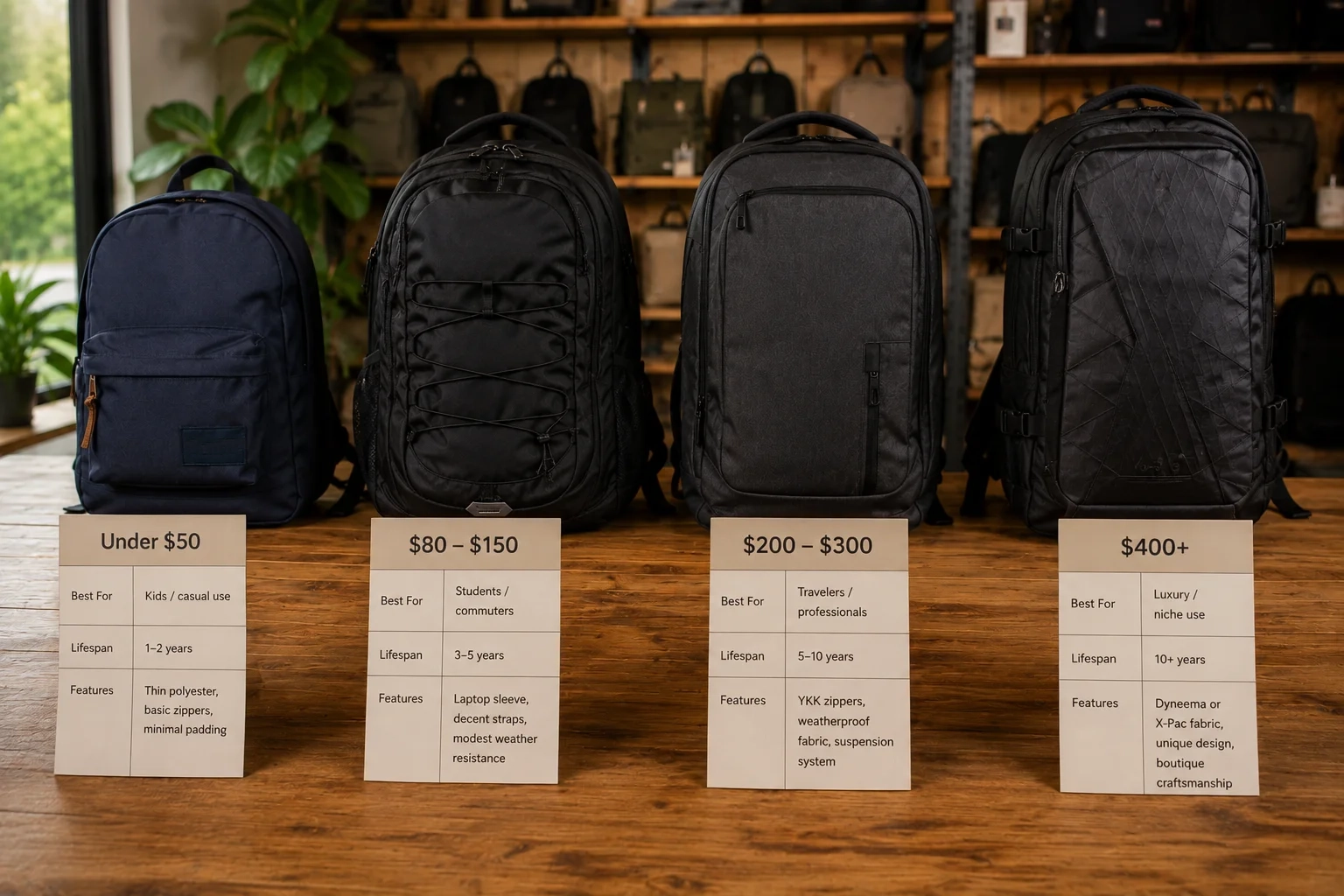
The manufacturing cost of a backpack is influenced by various factors, such as the country of production, the product type, and configuration requirements. To provide a cost analysis with greater practical value, this article uses a custom 15.6-inch laptop backpack manufactured in China as a case study to break down the cost components of backpack production in China for the year 2026 across three tiers: entry-level, mid-range, and high-end.
Breakdown of Backpack Manufacturing Costs
The manufacturing cost of a backpack typically comprises six major components:
-
- Fabric Cost
- Accessory Cost
- Labor Cost
- Packaging Cost
- Manufacturing Overhead
- Development & Customization Cost
Among these, material and labor costs account for a significant proportion—over 60%.
1. Fabric Cost
1.1 Entry-level Laptop Backpack
-
- Common Fabrics: Entry-level laptop backpacks typically use 600D polyester. Thanks to its excellent cost-performance ratio, good abrasion resistance, and stable supply, 600D polyester is also one of the most widely used base fabrics in global backpack manufacturing.
- Fabric Cost: Consumption is approximately 1.5 m², and the fabric price is about $1–$2/m², resulting in a cost of approximately $1.5–$3 per unit.
1.2 Mid-range Laptop Backpack
-
- Common Fabrics: 900D polyester is a common choice for mid-range laptop backpacks; compared to 600D, it offers superior abrasion resistance and a more premium feel.
- Fabric Cost: Consumption is approximately 1.5 m², and the fabric price is about $2–$3/m², resulting in a cost of roughly $3–$5 per unit.
1.3 High-end Laptop Backpack
-
- Common Fabrics: High-end laptop backpacks typically use 1680D nylon. It offers high strength, excellent abrasion resistance, and a premium look and feel, meeting the demands of long-term use.
- Fabric Cost: Consumption is approximately 1.5 m², and the fabric price is about $4–$8/m², resulting in a cost of roughly $6–$12 per unit.
2. Accessory Cost
In addition to the main fabric, a backpack requires a wide range of accessory materials to meet the product's structural, functional, and durability requirements.
2.1 Entry-level Laptop Backpack
-
- Common Auxiliary Materials: standard resin zippers, plastic hardware, basic webbing, and standard foam.
- Primarily provides basic opening/closing functionality and load-bearing support.
- Cost of Auxiliary Materials: approximately $0.8–$1.5 per unit.
2.2 Mid-range Laptop Backpack
-
- Common Auxiliary Materials: While the types of accessories generally remain the same as those found in entry-level models, higher-quality and more durable zippers, buckles, webbing, and cushioning materials are selected to enhance the overall user experience.
- Primarily provides enhanced comfort, stronger structural support, and a longer service life.
- Cost of Auxiliary Materials: approximately $1.5–$3 per unit.
2.3 High-end Laptop Backpack
-
- Common Auxiliary Materials: high-quality zippers, metal hardware, high-density foam, and functional accessories.
- Primarily provides enhanced protection, more advanced functional features, and a more premium user experience.
- Cost of Auxiliary Materials: approximately $3–$6 per unit.
In terms of materials, the cost breakdown for a laptop backpack is roughly as follows:
|
Product Tier |
Fabric Cost (Per Piece) |
Accessory Cost (Per Piece) |
|
Entry-level |
$1.5-$3 |
$0.8-$1.5 |
|
Mid-range |
$3-$5 |
$1.5–$3 |
|
High-end |
$6-$12 |
$3-$6 |
3. Labor Cost
Production labor costs encompass stages such as cutting, sewing, assembly, quality inspection, and packaging. Generally, the higher the product tier, the more labor costs will increase accordingly.
3.1 Entry-level Laptop Backpack
-
- Production Characteristics: The structure is relatively simple, involving fewer processing steps, and requirements for production techniques and machining precision are relatively low.
- Labor Cost: approximately $2–$3 per unit.
3.2 Mid-range Laptop Backpack
-
- Production Characteristics: It features a more complex structure and demands higher precision in manufacturing and workmanship; it typically incorporates design elements such as a padded laptop compartment, reinforced shoulder straps, and back support.
- Labor Cost: approximately $3–$5 per unit.
3.3 High-end Laptop Backpack
-
- Production Characteristics: The manufacturing process is complex, and production takes longer. It typically employs a combination of multi-layer structures, specialized sewing techniques, and functional structural designs, requiring workers to possess extensive production experience and strong process control capabilities.
- Labor Cost: approximately $5–$8 per piece.
Comparison of Labor Costs Across Three Tiers
|
Product Tier |
Labor Cost(Per Piece) |
|
Entry-level |
$2–$3 |
|
Mid-range |
$3–$5 |
|
High-end |
$5–$8 |
4. Packaging Cost
Compared to major costs such as fabrics and labor, packaging typically accounts for a relatively small share; however, significant variations arise depending on market positioning and brand requirements.
4.1 Entry-level Laptop Backpack
-
- Packaging Features: Focuses primarily on basic protection, typically utilizing standard PE plastic bags and basic cardboard boxes.
- Packaging Cost: approximately $0.2–$0.5 per unit.
4.2 Mid-range Laptop Backpack
-
- Packaging Features: Balancing protection with product display, it typically utilizes higher-quality packaging bags, cartons, and brand labels compared to standard products.
- Packaging Cost: approximately $0.5–$1 per unit.
4.3 High-end Laptop Backpack
-
- Packaging Features: Greater emphasis is placed on brand experience and shipping protection, potentially involving custom packaging boxes, specialized protective materials, and retail-grade packaging designs.
- Packaging Cost: approximately $1–$3 per unit.
Comparison of Packaging Costs Across Three Tiers
|
Product Tier |
Packaging Cost(Per Piece) |
|
Entry-level |
$0.2–$0.5 |
|
Mid-range |
$0.5–$1 |
|
High-end |
$1–$3 |
5. Manufacturing Overhead
Manufacturing overhead differs from the previously mentioned costs; while it is not directly attributable to a specific production process, it is an indispensable component of stable production, comprising:
-
- Factory operating costs
- Depreciation and maintenance of production equipment
- Utility and energy consumption
- Production management personnel costs
- Quality management costs
- Costs of production tools and consumables
Manufacturing overhead is typically allocated to each product based on production volume and manufacturing efficiency.
|
Product Tier |
Manufacturing Overhead(Per Piece) |
|
Entry-level |
$1–$2 |
|
Mid-range |
$2–$3 |
|
High-end |
$3–$5 |
6. Development & Customization Cost
Development and customization costs primarily apply to new OEM/ODM projects and typically occur during the initial product development phase. Once the product enters stable mass production, this cost is generally not incurred again for repeat orders of the same model. Furthermore, this cost is sensitive to the Minimum Order Quantity (MOQ); the larger the order volume, the lower the development cost allocated to each individual product.
6.1 Entry-level Laptop Backpack
-
- Characteristics: Typically based on existing factory models with modifications, requiring lower investment.
- Development Cost: Approximately $100–$500 per style.
- Based on an MOQ of 500 units: Approximately $0.2–$1 per unit.
6.2 Mid-range Laptop Backpack
-
- Characteristics: Typically requires a certain level of product optimization, as well as more extensive prototyping and testing processes.
- Development Cost: $500–$1,500 per style.
- Based on an MOQ of 500 units: approximately $1–$3 per unit.
6.3 High-end Laptop Backpack
-
- Characteristics: These typically involve brand-new OEM development projects, potentially encompassing original product design, the development of specialized structures, and the testing of new materials.
- Development Cost: $1,500–$5,000+ per style.
- Based on an MOQ of 500 units: approximately $3–$10 per unit.
Conclusion
Taking a MOQ of 500 units as an example, the manufacturing costs for custom 15.6-inch laptop backpacks produced in China in 2026 are shown in the table below.
|
Entry-level |
Mid-range |
High-end |
|
|
Fabric Cost |
$1.5–$3 |
$3–$5 |
$6–$12 |
|
Accessory Cost |
$0.8–$1.5 |
$1.5–$3 |
$3-$6 |
|
Labor Cost |
$2–$3 |
$3–$5 |
$5–$8 |
|
Packaging Cost |
$0.2–$0.5 |
$0.5–$1 |
$1–$3 |
|
Manufacturing Overhead |
$1–$2 |
$2–$3 |
$3–$5 |
|
Development & Customization Cost |
$0.2–$1 |
$1–$3 |
$3–$10 |
|
Total |
$5.7–$11 |
$11–$20 |
$21–$44 |
As costs vary by bag category, material configuration, functional requirements, and manufacturing location, please feel free to contact us for further insights into other products, including outdoor bags, handbags, and travel bags, as well as manufacturing cost comparisons between China and Vietnam.
FAQ
Q1: How much does it cost to manufacture a backpack in China?
A: Taking a custom 15.6-inch laptop backpack as an example:
-
- Entry-level models: approx. US$6–11 per unit;
- Mid-range models: approx. US$11–20 per unit;
- High-end models: approx. US$21–44 per unit.
Actual costs will vary depending on materials, functional design, customization requirements, and MOQ.
Q2: What factors affect backpack manufacturing costs?
A: Materials, complexity of the production process, order quantity, packaging, etc.
Q3: Will the manufacturing cost of the backpacks decrease if the MOQ is higher?
A: Usually, yes.
Related Reading
1. How to Reduce Custom Bag Manufacturing Costs Without Lowering Quality