 EN
EN


Introduction
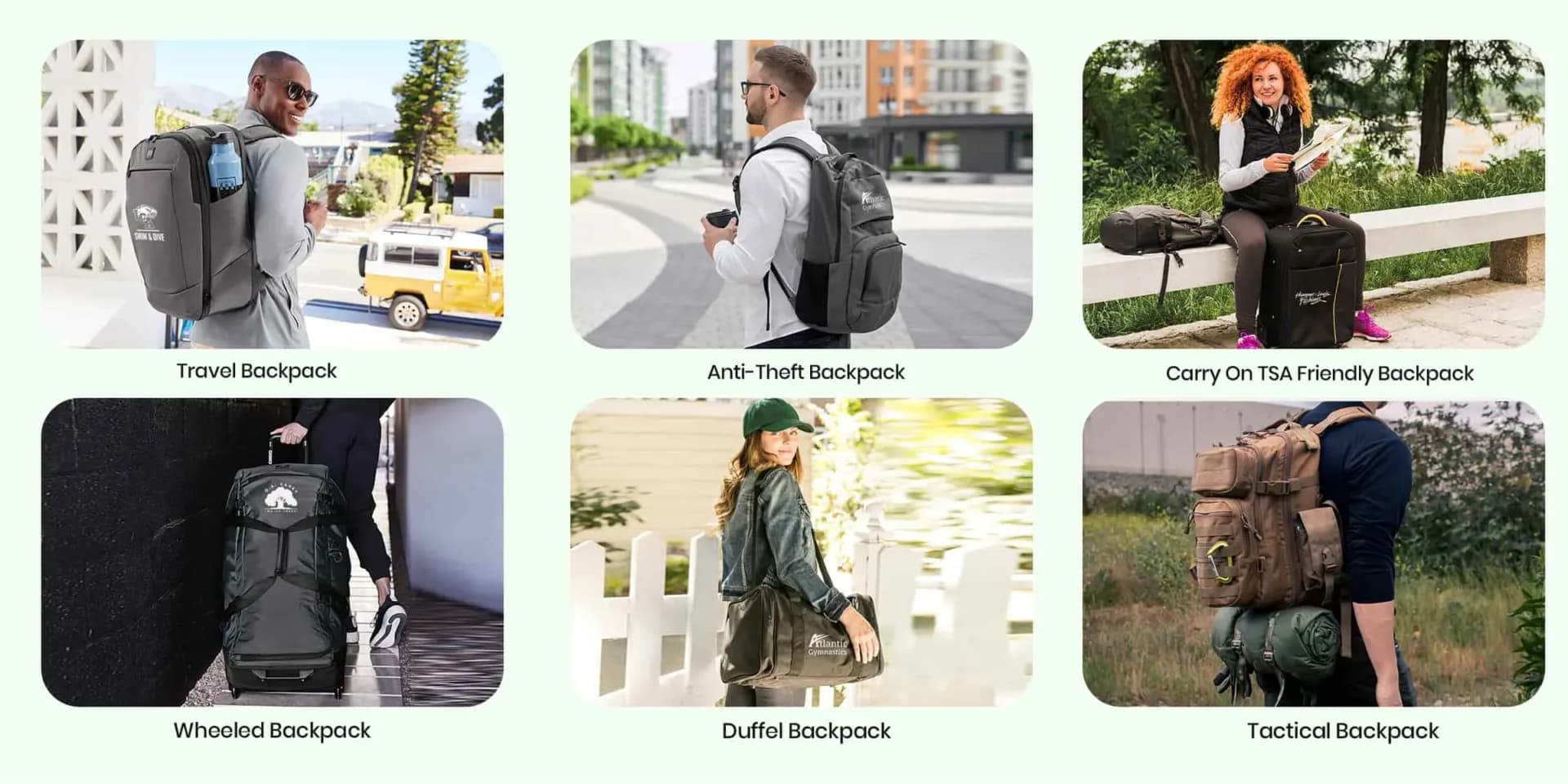
As a common carrying accessory in modern life, the backpack has become an indispensable item for students, travelers, and professionals alike.
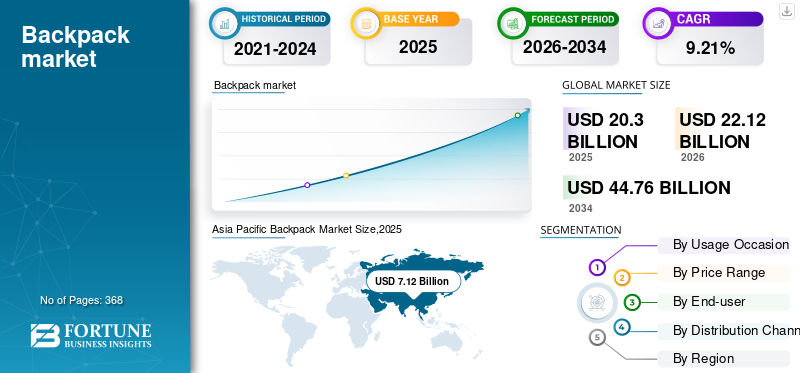
According to the latest market data from Fortune Business Insights, the global backpack market was valued at $20.3 billion in 2025 and is projected to grow to $44.76 billion by 2034, with a compound annual growth rate (CAGR) of 9.21% during the forecast period. The Asia-Pacific region dominates the backpack market, holding a 37.66% market share in 2025.
Key factors driving market growth include the growing interest in outdoor recreational activities and the increasing popularity of tech-friendly, ergonomic backpacks, a trend further reinforced by the widespread use of laptops in workplaces and schools.
This article examines key backpack categories, analyzing their market positions, product features, and noteworthy niche segments.
1. Travel Backpacks
1.1 Market Position and Product Features
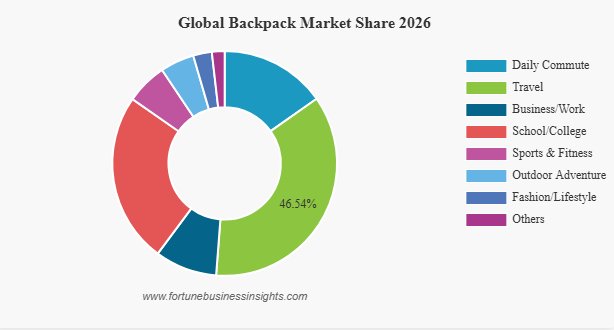
Travel currently represents the largest use case in the backpack market, with a projected global market share of 46.54% by 2026—far exceeding that of other categories.
The reason "Travel" has become the largest segment of the backpack market is primarily due to the broad consumer demand for travel backpacks. Unlike backpacks designed for specific use cases, travel backpacks offer significant functional versatility, making them suitable for leisure vacations, business trips, weekend getaways, and even certain outdoor activities; this "multi-purpose" nature further expands the potential consumer base for travel backpacks.
This is also causing the product boundaries between travel backpacks, business backpacks, and commuting backpacks to gradually blur. Hybrid designs that combine travel, work, and daily commuting are becoming a key direction in the development of travel backpacks.
1.2 Trending Subtypes
1.2.1 Laptop Travel Backpacks
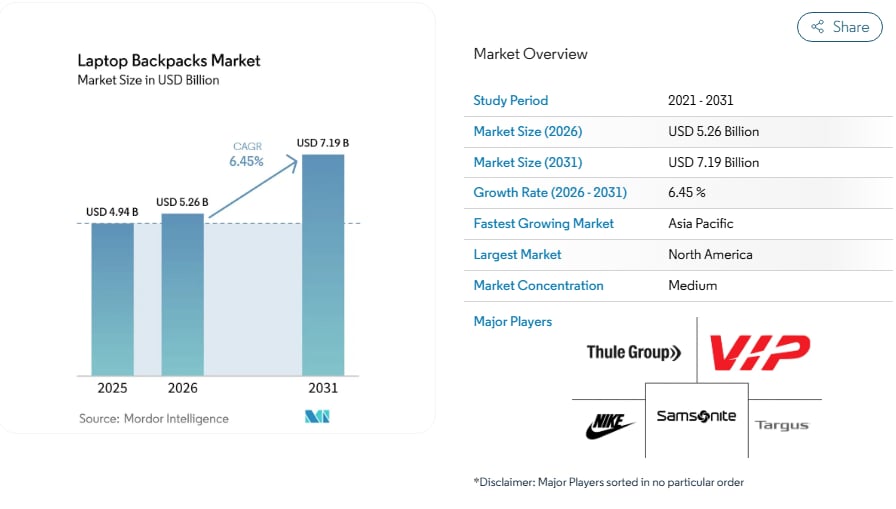
According to data from Mordor Intelligence, the global laptop backpack market was valued at approximately $4.94 billion in 2025 and is projected to reach $7.19 billion by 2031, growing at a CAGR of 6.45% from 2026 to 2031.
This market growth is closely linked to the rise of digital work and the consumer need to carry computers while on the go. Consequently, an increasing number of travel backpacks now feature dedicated compartments for laptops and tablets, as well as storage for other electronic devices, enabling them to meet both travel and work requirements.
1.2.2 Carry-On Travel Backpacks
With the evolving demand for airline carry-on luggage, carry-on travel backpacks have emerged as a noteworthy product category within the travel backpack market.
In reviews and buying guides for professional travel backpacks for 2026, a vast number of products are designed with a focus on airline carry-on compliance, capacity management, and efficient organization; the 28–35L range is also regarded by numerous travel gear experts as a standard capacity bracket.
2. School & College Backpacks
2.1 Market Position and Product Features
Schools and colleges represent the second-largest use case for backpacks.
Students need to carry books, stationery, laptops, tablets, and personal items on a regular basis, creating a steady, fundamental demand for school backpacks. Furthermore, the high frequency of use—along with issues such as wear and tear and changing capacity requirements—drives repeat purchases.
Currently, school backpacks are evolving from traditional "high-capacity bookbags" toward designs that are digital-device-friendly, ergonomic, and youthful.
2.2 Trending Subtypes
2.2.1 Laptop School Backpacks
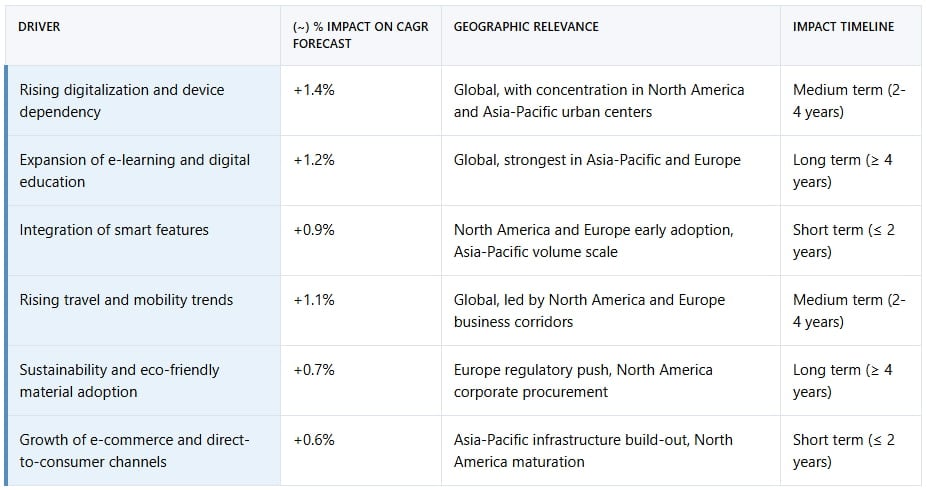
Mordor Intelligence notes that the rapid growth of e-learning and digital education is a key factor driving the global laptop backpack market, projected to contribute a compound annual growth rate (CAGR) of 1.2%.
Students of all ages are increasingly relying on laptops and tablets for virtual classroom learning, completing assignments, and engaging in collaborative study. This shift has led to a surge in demand for backpacks capable of securely and neatly carrying laptops, chargers, books, and other study essentials.
2.2.2 Ergonomic School Backpacks
A study of 489 primary school students aged 7–12 found that 66.7% of the participants experienced musculoskeletal discomfort, with the shoulders and neck being the most common sites; the study also found that a backpack weight exceeding 10% of the child's body weight was associated with a higher risk of musculoskeletal discomfort.
This issue is driving the evolution of school backpacks toward greater lightness and improved ergonomics. Features such as wide shoulder straps, chest straps, waist belts, breathable back panels, and optimized weight distribution are increasingly being incorporated to reduce strain and enhance comfort during prolonged use.
3. Daily Commute Backpacks
3.1 Market Position and Product Features
Daily commuting is the third most important backpack use scenario, after travel and school.
Daily commuting backpacks are primarily designed for frequent urban travel. As consumers typically carry them between home, the office, coffee shops, and other locations associated with their daily routines, the product needs to strike a balance between professional requirements and everyday life.
In addition to carrying everyday items such as laptops, tablets, chargers, and water bottles, consumers are increasingly prioritizing lightweight design, carrying comfort, and portability in urban environments. Therefore, modern commuting backpacks typically feature a clean, understated urban design and meet the demands of frequent daily use through a well-organized storage structure.
3.2 Trending Subtypes
3.2.1 Laptop Commuter Backpacks
Mordor Intelligence notes that the increasing level of digitalization and the growing reliance on electronic devices are among the key factors driving the growth of the global laptop backpack market. As laptops have increasingly become standard tools for study and work, commuting backpacks have evolved from traditional everyday carry items into products that place greater emphasis on protecting electronic devices.
Consequently, features such as a dedicated laptop compartment, storage for multiple devices, and charger organization have gradually become key design elements of laptop commuter backpacks.
3.2.2 Multifunctional Commuter Backpacks
The daily activities of modern commuters are becoming increasingly diverse; a single backpack may need to serve a range of purposes, from office commuting to business travel, gym sessions, and short leisure outings. Consequently, consumers no longer focus solely on whether a backpack is suitable for the workplace; instead, they place greater importance on the product's ability to adapt flexibly to various usage scenarios.
This shift from "solely for commuting" to "a single bag covering various daily scenarios" is becoming a key direction in the development of commuter backpacks.
4. Business & Work Backpacks
4.1 Market Position and Product Features
Business and work backpacks rank fourth among global backpack usage scenarios.
Business and work backpacks are primarily designed for professional settings such as offices, business meetings, and client visits. Unlike commuter backpacks that prioritize convenience for daily travel, these products place greater emphasis on a professional image, business-oriented functionality, and internal organizational capabilities. Some business backpacks also feature compartments for quick laptop access, dedicated document sections, and designs tailored for airport security and business travel, thereby enhancing efficiency in work and travel scenarios.
4.2 Trending Subtypes
4.2.1 Business Laptop Backpacks
Business laptop backpacks represent one of the most mature segments within this category.
Data from GlobalInfoResearch indicates that the global business laptop backpack market was valued at approximately US$656 million in 2024 and is projected to reach US$884 million by 2031, growing at a CAGR of 4.7%.
Designed primarily for corporate, academic, and professional settings, business laptop backpacks typically feature clean, sleek lines and a minimalist aesthetic. They utilize durable, high-quality materials—such as ballistic nylon, leather, and water-resistant fabrics—to strike a balance between practicality, durability, and a professional appearance.
4.22 Business Travel Backpacks
According to Intel Market Research, the global business travel backpack market was valued at approximately $1.95 billion in 2025 and is projected to reach $3.8 billion by 2034, with a CAGR of 7.5% from 2026 to 2034.
Business travel backpacks are designed for professionals who value a blend of functionality, durability, and style. These backpacks feature dedicated laptop compartments, document pockets, RFID-blocking pockets, and ergonomic shoulder straps; crafted from materials such as PU leather, high-strength nylon, and sustainably sourced recycled fabrics, they offer a perfect balance of performance and aesthetics.
5. Sports & Fitness Backpacks
5.1 Market Position and Product Features
Sports and fitness is another important use case for backpacks.
This market primarily caters to activities such as fitness training, running, cycling, ball sports, and other forms of daily exercise. Compared to standard backpacks, sports backpacks place greater emphasis on being lightweight and breathable, as well as on their capacity to store sports gear.
Consumers' continued focus on healthy lifestyles sustains steady demand for sports-related backpacks.
5.2 Trending Subtypes
Gym Backpacks
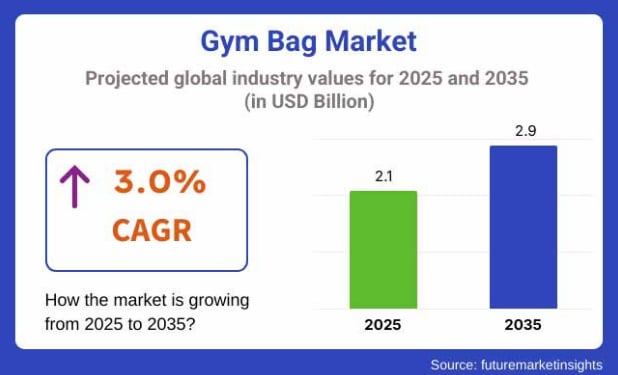
Data from Fortune Business Insights indicates that the global gym bag market is projected to grow from $2.1 billion in 2025 to $2.9 billion in 2035, at a CAGR of 3%. Among the various types, the backpack style is the most popular.
Consumers generally seek designs that offer hands-free convenience, comfort, and multi-compartment storage. Companies are actively developing gym backpacks featuring practical elements such as breathability, padded shoulder straps, and integrated technology.
6. Outdoor Adventure Backpacks
6.1 Market Position and Product Features
Although the current market size for "Outdoor Adventure" is relatively small, it is the segment projected to experience the fastest future growth among key usage scenarios.
The growth of outdoor activities such as hiking, camping, and mountaineering has generated increased demand for functional outdoor backpacks. Unlike standard backpacks, these must withstand more challenging outdoor environments; consequently, product development places greater emphasis on carrying performance, durability, weight management, and the capacity to carry outdoor gear.
6.2 Trending Subtypes
6.2.1 Hiking Backpacks
Hiking backpacks are the most important segment of the outdoor adventure backpack market.
Data from Future Market Insights indicates that the global hiking backpack market was valued at approximately $5.8 billion in 2025 and is projected to reach $11.1 billion by 2036, growing at a CAGR of 6.1% from 2026 to 2036.
Among them, lightweight backpacks with a capacity of 20–40 liters account for 41.0%, while multi-day backpacks (30–65 liters) make up 33.0%; in terms of materials, nylon remains the mainstream choice, holding a 46.0% market share.
6.2.2 Lightweight Outdoor Backpacks
Data from PW Consulting indicates that the global ultralight backpack market was valued at approximately US$650 million in 2025 and is projected to reach US$1.01 billion by 2032, growing at a CAGR of 6.51% during the 2025–2032 period; notably, products with a capacity of less than 40L accounted for approximately 50.1% of the market share in 2025.
This growth trend indicates that the ultralight backpack market will continue to expand steadily, driven by rising demand for outdoor recreation, travel, and modular gear systems, as well as an increasing consumer preference for lighter, more portable equipment.
Conclusion
The 2026 backpack market is shifting from traditional category-based segmentation toward a more pronounced blending of usage scenarios and a combination of functions. The boundaries between travel, commuting, business, and lifestyle are increasingly blurring, and consumers are looking for backpacks that can adapt to multiple scenarios rather than serving only a single purpose.
This shift is also influencing the product development logic for backpacks. Future product design will move beyond simple categorization to focus more closely on the actual usage needs of target consumers. Combining features and employing differentiated designs tailored to specific consumption scenarios will become a key direction for future backpack product innovation and market competition.
Related Reading