 EN
EN


The modern traveler is no longer satisfied with a one-size-fits-all approach to gear. As travel habits evolve — from weekend urban escapes to multi-week outdoor expeditions — the demand for a customized travel backpack has grown steadily across both consumer and B2B markets. Brands, corporate buyers, and individual travelers alike are pushing manufacturers to deliver designs that reflect specific functional needs, aesthetic preferences, and practical use cases. This shift is not simply a trend; it represents a fundamental change in how people relate to their travel gear.
Understanding how the customized travel backpack segment is adapting to these personalized demands requires looking at design philosophy, material selection, ergonomic development, and the business forces driving customization at scale. Whether you are a procurement professional sourcing branded corporate gifts, a retail buyer selecting private-label products, or a brand founder building a travel accessories line, knowing what drives personalization in backpack design will help you make smarter sourcing decisions. This article breaks down the key ways design adaptation is happening and what it means for buyers and end users.
The Shift Toward Personalized Functionality
Travelers Are Defining Their Own Use Cases
Gone are the days when travelers accepted whatever compartmentalization a standard bag offered. Today, a frequent flier has completely different organizational priorities compared to a gym-going traveler or a weekend hiker. The customized travel backpack market has responded by offering modular interior layouts, removable dividers, and configurable pockets that allow users — or brand buyers — to specify exactly what internal architecture the bag should have.
For B2B buyers sourcing large quantities, this functional personalization is especially valuable. A tech company ordering corporate travel bags for its sales team may want dedicated padded laptop sleeves, cable management loops, and power bank access ports. A fitness brand, on the other hand, may require wet-dry separation compartments, ventilated shoe pockets, and hydration bladder compatibility. Manufacturers who offer a customized travel backpack solution that adapts to these divergent functional requirements are capturing growing market share.
This use-case-driven design logic has also expanded into capacity customization. Buyers can now specify whether a bag should be carry-on compliant, expandable, or built for heavy-load distribution over long distances. The ability to engineer the bag around the traveler's specific journey type — rather than forcing the traveler to compromise — is what defines modern personalized design.
Multi-Function Demands Are Reshaping Interior Architecture
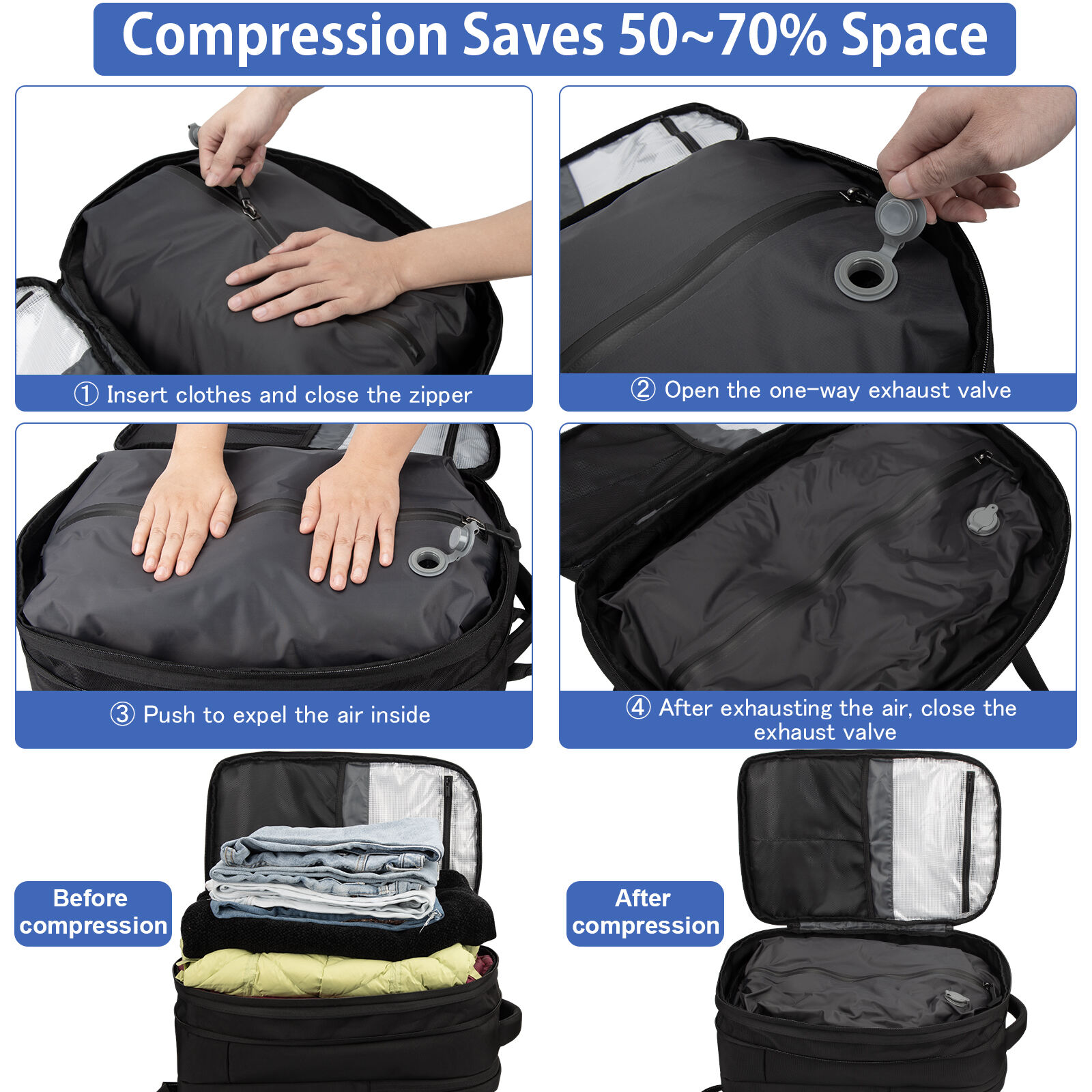
One of the most visible ways the customized travel backpack is adapting to personalized needs is through the development of multi-function interior systems. Modern travelers expect their bag to function as a carry-on, a gym bag, a day pack, and a work bag — sometimes all within the same trip. This has driven manufacturers to rethink how interior space is architected and how that architecture can be specified at the order level.
Interior design customization now includes options like expandable main compartments, convertible organizational panels, and hidden security pockets. For buyers placing custom orders, the ability to choose which of these features to include — and where to position them — translates into a product that genuinely serves their audience. A customized travel backpack with multi-function architecture is not just more useful; it communicates to the end user that the brand understands their lifestyle.
From a manufacturing perspective, this level of interior flexibility requires sophisticated pattern engineering and modular production workflows. Suppliers who have invested in these capabilities are able to offer buyers a meaningful degree of interior design control without requiring entirely new tooling for every project, making customization more accessible at practical minimum order quantities.
Material and Aesthetic Personalization at Scale
Fabric Selection as a Brand and Performance Statement
Material choice is one of the most impactful levers in customized travel backpack production. The right fabric communicates a brand's values — whether that is rugged durability, lightweight performance, sustainable sourcing, or premium aesthetics. As buyer sophistication has increased, so has the expectation that custom orders will offer meaningful material choice rather than just surface-level color variations.
High-denier nylon and polyester remain industry staples for travel bags due to their abrasion resistance and weight-to-strength ratios. However, buyers are increasingly requesting recycled fabric options, water-resistant coatings such as TPU lamination or DWR finishes, and even specialized materials like ripstop canvas or ballistic nylon for premium tiers. The customized travel backpack as a product category now sits at the intersection of functional engineering and material storytelling.
Waterproofing is a particularly high-priority specification for travel-focused buyers. Whether it is resistance to sudden rain showers on a mountain trail or protection against overhead bin spills during a flight, water-resistant construction has moved from a premium feature to a near-standard expectation. Buyers specifying a customized travel backpack for outdoor or adventure-oriented audiences should treat waterproof material as a baseline requirement rather than an upgrade.
Color, Branding, and Visual Identity Integration
Beyond materials, the visual identity of a customized travel backpack is one of the most powerful tools a brand has for standing out in a competitive market. Logo placement, colorway selection, hardware finishes, and label design all contribute to the overall brand impression a bag makes. For corporate buyers, these visual elements must align precisely with brand guidelines. For retail buyers, they must resonate with the target consumer's aesthetic preferences.
Modern customization workflows allow buyers to specify Pantone-matched colors for both fabric and hardware, choose from multiple logo application techniques — including embroidery, woven patches, debossed leather tags, and heat transfer printing — and even customize zipper pulls and lining fabric colors. This level of detail is what separates a truly customized travel backpack from a generic bag with a logo slapped on the front panel.
Visual customization also extends to interior lining. Branded interior prints, custom woven labels with care instructions, and co-branded hang tags all contribute to an unboxing and in-use experience that reinforces brand equity. For buyers who understand the value of brand touchpoints, these details are not trivial — they are strategic investments in customer perception.
Ergonomic Design Adaptation for Diverse User Profiles
Building for the Body, Not Just the Load
A customized travel backpack that looks great but causes shoulder or back discomfort after an hour of use fails its primary purpose. This is why ergonomic adaptation has become a central pillar of personalized backpack design. Manufacturers are now offering buyers choices in back panel systems, shoulder strap profiles, sternum strap positioning, and hip belt configurations — all of which affect how the bag carries across different body types and load weights.
For travel-specific applications, the ergonomic priorities differ from those of a hiking pack. Travel bags are frequently carried through airports, city streets, and transit systems — environments where the bag is worn for shorter durations but in more varied and unpredictable conditions. A customized travel backpack designed for this context typically features an air-mesh back panel for ventilation, contoured shoulder straps with memory foam or EVA padding, and a luggage pass-through sleeve for attaching to rolling suitcases.
Buyers sourcing for a diverse user base should consider whether ergonomic options can be standardized in their custom order or whether size variants are warranted. Some manufacturers offer the same custom design in multiple torso lengths or with adjustable suspension systems, allowing a single SKU to serve a broader demographic without requiring entirely separate production runs.
Weight Distribution and Large Capacity Engineering
Large-capacity travel backpacks — those designed to serve as primary luggage rather than secondary day packs — present unique engineering challenges. A customized travel backpack in the 40L to 60L range must distribute weight intelligently to prevent the load from pulling away from the body, which causes fatigue and discomfort over extended wear. This requires attention to internal frame design, load lifter straps, and the placement of heavy item zones within the main compartment.
Buyers specifying large-capacity custom bags should ask manufacturers about internal frame options — whether that is a removable aluminum stay, a semi-rigid foam panel, or a full framesheet. These structural elements significantly affect how the bag carries at full load and directly influence the end user's experience. A well-engineered customized travel backpack with thoughtful weight distribution will receive far better reviews and retention rates than one that prioritizes appearance at the expense of carry comfort.
Compression straps and load stabilizer systems are additional ergonomic features that large-capacity custom bags should incorporate. These allow the user to compress the bag's volume when not fully packed, keeping the load centered and reducing swing during movement. For travel applications where the bag transitions between fully packed and partially loaded states, these features significantly improve the daily usability of the product.
Sustainability and Responsible Customization
Eco-Conscious Material Choices in Custom Production
Sustainability has moved from a marketing talking point to a genuine procurement criterion for many buyers. When sourcing a customized travel backpack, an increasing number of brands and corporations are requiring that materials meet recognized environmental standards. This includes the use of recycled polyester (rPET) made from post-consumer plastic bottles, organic cotton for lining fabrics, and hardware that meets REACH or RoHS compliance requirements.
For buyers with ESG commitments or sustainability-focused brand identities, specifying eco-conscious materials in a custom backpack order is both a values statement and a practical differentiator in the market. Consumers who identify as environmentally conscious are increasingly willing to pay a premium for products they perceive as responsibly made. A customized travel backpack that leads with recycled materials and responsible production is well positioned to capture this segment.
It is important for buyers to verify claims through documentation. Reputable manufacturers should be able to provide material certifications, factory audit reports, and traceability documentation for any sustainability-related claims. The difference between a genuinely sustainable customized travel backpack and one that simply uses sustainability language in marketing comes down to verifiable supply chain transparency.
Durability as a Sustainability Strategy
Beyond material sourcing, one of the most impactful sustainability strategies in backpack design is simply building for longevity. A customized travel backpack that lasts five to ten years of regular use generates far less environmental impact per use than a cheaper bag that fails within a year and ends up in landfill. This is why durability specification — including reinforced stress points, YKK or equivalent zippers, bar-tack stitching, and quality-tested hardware — is an integral part of responsible customization.
For B2B buyers, durable construction also reduces warranty claims, return rates, and brand reputation risk. Investing in higher-quality components during the customization process delivers a better long-term return on the sourcing investment. This is particularly relevant for corporate gift programs and loyalty merchandise, where the product's longevity directly reflects on the sponsoring brand every time the recipient uses the bag.
FAQ
What is the typical minimum order quantity for a customized travel backpack?
Minimum order quantities for a customized travel backpack vary by manufacturer and the degree of customization required. For relatively standard customization such as logo printing and color selection, MOQs typically range from 100 to 300 pieces. For projects requiring structural or interior layout modifications, MOQs may be higher, often starting at 500 pieces or more. It is advisable to discuss your specific customization scope with the supplier early in the process to understand tooling costs and production minimums.
How long does production take for a custom backpack order?
Production lead times for a customized travel backpack depend on the complexity of the design, the availability of materials, and the factory's current capacity. Standard custom orders — involving color, logo, and minor detail changes — typically require 30 to 45 days after sample approval. More complex designs involving new patterns or unique hardware may extend this timeline to 60 to 90 days. Buyers should factor in shipping time and buffer for revisions when planning seasonal or campaign-driven procurement schedules.
Can small brands or startups access customized travel backpack production?
Yes, many manufacturers now offer accessible entry points for smaller buyers. Some suppliers have developed semi-custom programs where a customized travel backpack base model can be specified with brand colors, logo application, and select feature additions at lower MOQs. This approach allows small brands and startups to launch with a professional, differentiated product without the investment required for a fully bespoke design. Working with a supplier experienced in small-batch customization can significantly reduce the barrier to entry.
What quality checks should be conducted on a customized travel backpack order?
Quality assurance for a customized travel backpack order should include pre-production sample review, in-line production inspection, and final random inspection before shipment. Key quality checkpoints include stitching integrity at stress points, zipper function and pull strength, color accuracy against approved Pantone references, logo placement and application durability, and waterproofing performance if specified. Engaging an independent third-party inspection service is highly recommended for large orders to ensure the finished product meets the agreed specifications before it leaves the factory.